Top Stories; US workers increasingly trapped in the 'Great Detachment' as hiring slows, report shows
Top Stories — Wednesday, April 8, 2026
What is trending in the USA today? Here is Breaking News:
- US workers increasingly trapped in the 'Great Detachment' as hiring slows, report shows — Fox Business
- How China Built Its Vast Natural Gas Stockpile — nyt News
- He Got Rich Buying and Selling Luxury Watches. Was It a Ponzi Scheme? — nyt News
US workers increasingly trapped in the 'Great Detachment' as hiring slows, report shows
Source: Fox Business • Published: 4/8/2026, 9:47:10 AM
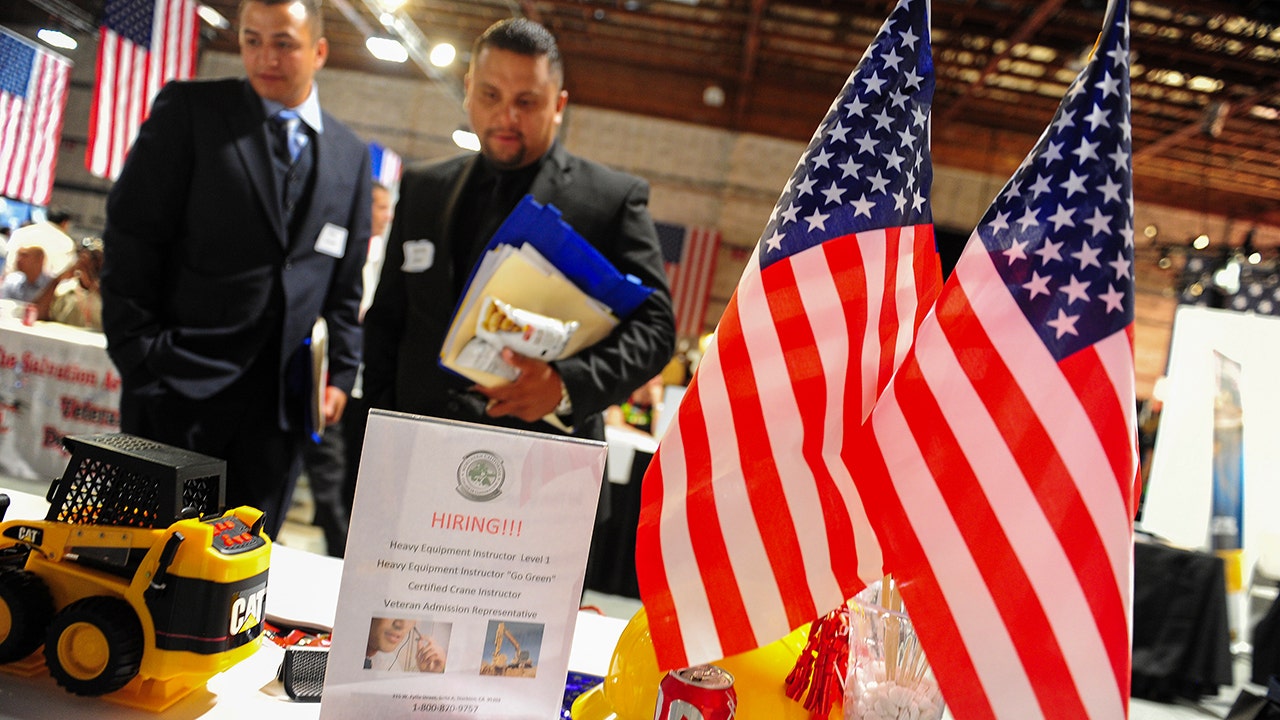
A new report from Gallup finds that U.S. workers are less optimistic about the job climate and their level of engagement with their current jobs has remained relatively flat.
Gallup released its 2026 State of the Global Workplace report on Wednesday, which showed that while 51% of global workers think it's a good time to find a quality job, the sentiment among U.S. workers declined to 28% in the fourth quarter of 2025.
That figure represents a notable decline from 46% in the fourth quarter of 2024, continuing a steep downward trend from the 70% reading in the second quarter of 2022.
"Folks with degrees, they're having a particularly difficult time finding a job," Jim Harter, chief scientist of workplace management and well-being for Gallup, told FOX Business. "So there's really a kind of interesting dynamic going on right now where unemployment is fairly low, it's on the uptick a little bit, but hiring isn't happening."
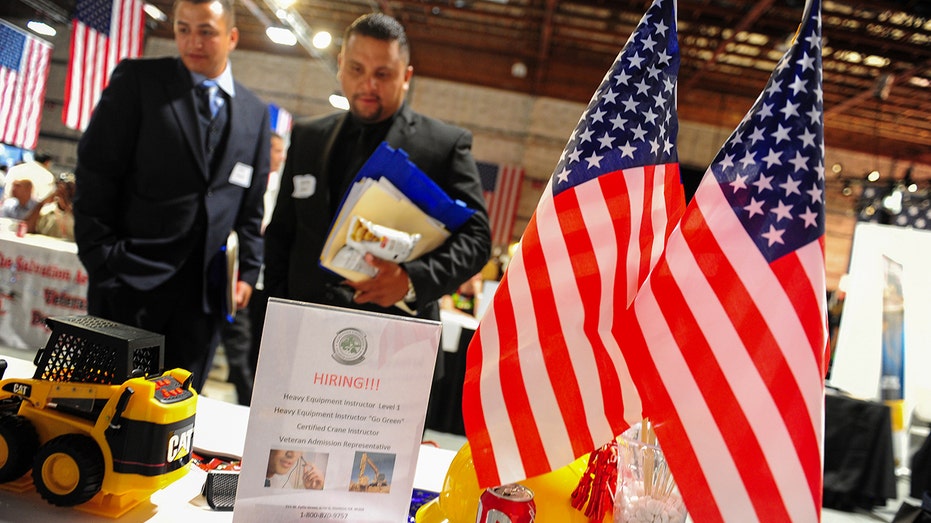
Gallup's report showed declining engagement among American workers along with lower engagement levels. (Robyn Beck/AFP via Getty Images)
"The job climate, just in terms of people's freedom, they're feeling stuck where they're at. Part of the solution to that is organizations need to get better at driving systems of really solid performance management and good communication between managers and employees," Harter said.
When workers feel stuck and like they don't have a choice about finding another quality job, Harter said that their "engagement will start to drop, and active disengagement will start to go up when people lack choice because they're stuck in jobs that they don't want."
Workers who said they're looking to find a new job reported not getting much of a response even after applying for multiple jobs, Gallup found.
"We do see that people are applying for jobs, but they're just not getting much response. There's just not much out there from a hiring standpoint right now," Harter said. "It's just not a really good time right now on the hiring end and, again, unemployment's fairly low, so people are in jobs – but they're jobs that they don't consider to be high quality jobs."
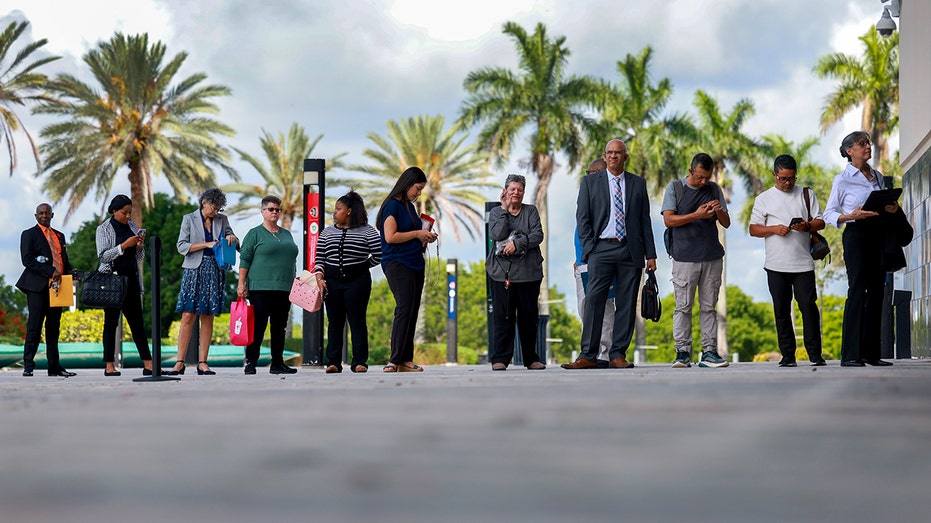
Workers who are actively looking for new jobs have struggled to get a response, Harter said. (Joe Raedle/Getty Images)
Harter noted that among respondents who say they have the ability to do multiple things, their perception of the job climate was more favorable.
"I think that there's a big factor in terms of upskilling related to AI that could be a big component of people being able to find jobs going into the future," he added.
The report's findings also demonstrated conditions that Gallup has called the "Great Detachment" in which people are actively looking for work or watching for openings while also reporting low levels of satisfaction with their current employer.
"Even though the employees have less choice in terms of leaving their employer to go somewhere else, there's psychological turnover meaning they're not bringing their whole selves to help the organization improve," Harter said.
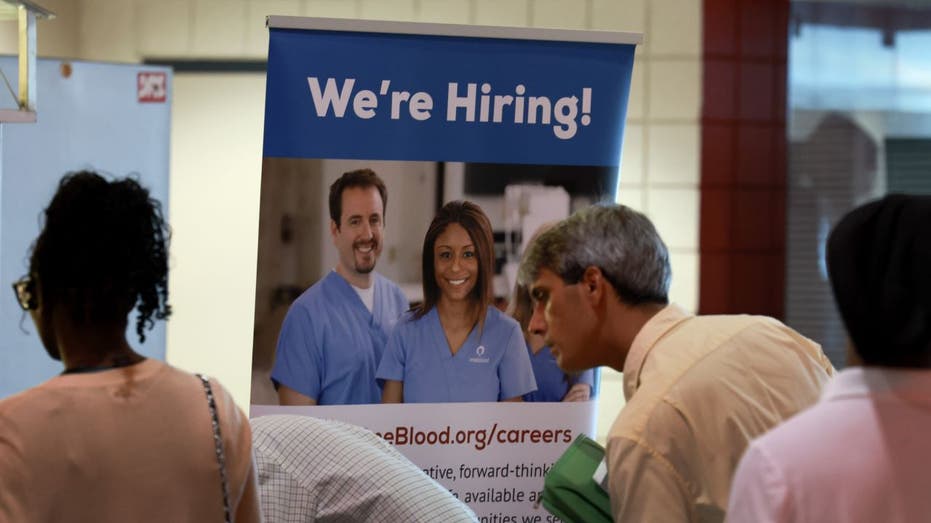
Highly successful organizations have higher levels of engagement among workers, Harter noted. (Joe Raedle/Getty Images)
The report also found that the three-year rolling average of engaged workers declined a point to 31%, with 52% of workers not engaged and 17% actively disengaged. At 31%, the level of engagement among U.S. workers is at its lowest level since 2014, while the share of actively disengaged workers at 17% was also at 2014 levels.
By contrast, Harter said that the top organizations have 70% or more of their employees engaged, along with managers who are engaged to an even greater extent.
"When you look closely at organizations that are really doing a great job right now, they are figuring out ways to get it done," he said. "They actually upskill their managers, they get people into the right managerial role – that helps when you flatten the organization and people can take on a higher span of control as managers. They help people see how their work connects to the bigger purpose of the organization."
"What we're talking about here is very solvable, but it's an uphill, kind of against-the-wind battle right now where leaders need to be very intentional about what they do with their staff and particularly with their managers and how they get prepared to coach people on a regular basis and help people feel like they're a part of what the overall organization is trying to get done," Harter added.
Read the full story at Fox Business.
How China Built Its Vast Natural Gas Stockpile
Source: nyt News • Published: 4/8/2026, 9:30:17 AM


Reporting from Yancheng, China
Two rows of storage tanks the height of 20-story buildings, filled with liquefied gas, help explain why China is better prepared than many countries to endure the interruption of gas supplies from the Middle East.
Each of six tanks in Yancheng, an industrial port, holds enough natural gas to meet the household needs of Beijing’s 22 million people for more than two months. Adjacent to them are four more tanks that are only slightly smaller.
The storage tanks are part of a huge effort by China over the past decade to accumulate stockpiles of all kinds of commodities, from pork and rice to rare-earth metals and coal, in case of a disruption of overseas supplies. But the natural gas stockpiles — the world’s largest above ground are in Yancheng, with more giant storage tanks in southern China — are conspicuously important now. They have helped China cushion the supply shock caused by the war in the Middle East even as its Asian neighbors, including India, Pakistan and Vietnam, are running low on natural gas.
On Tuesday evening, the United States and Iran reached a cease-fire deal that would open the strait and allow tankers and other freighters carrying oil, gas and other commodities to proceed through the Strait of Hormuz. The strait has been effectively closed since the first U.S.-Israeli strikes on Iran five and a half weeks ago.
No matter when regular traffic resumes, Qatar, a country on the Persian Gulf and one of the world’s top exporters of liquefied natural gas, has said it may take years to repair its gas facilities.
China is the world’s largest importer of natural gas and the largest consumer of fertilizer, much of which is made from natural gas. China also has the biggest chemicals industry, much of which requires natural gas as well.
The country has other supply options besides the storage tanks, which hold liquefied natural gas brought in by sea. It has constructed pipelines to gas fields in Central Asia and Russia. China has developed coal-based processes that can replace natural gas in making some kinds of chemicals. And China has more than doubled its domestic production of natural gas in the past decade through fracking and other technologies.
While the United States now leads the world in oil and natural gas production by a wide margin, China is the fourth-largest producer of natural gas, trailing only the United States, Russia and Iran. China is the fifth-largest oil producer, behind the United States, Saudi Arabia, Russia and Canada.
Chinese government data shows that natural gas imports through the Strait of Hormuz represented only 6.9 percent of the country’s overall gas consumption last year.
Beijing’s top leaders have long been preoccupied with their country’s vulnerability to pressure from the American or Indian Navy on their seaborne supply of oil and natural gas from the Middle East. The country’s programs to develop solar and wind power and electric cars as alternatives to oil all moved into high gear 20 years ago.
“They’ve been thinking about this for a long time,” said Geoffrey Garrett, the dean of the Marshall School of Business at the University of Southern California.
China’s expansion of strategic stockpiles of fossil fuels is more recent, an effort pushed by its top leader, Xi Jinping. He has uttered dark warnings about the challenges facing the globe and the need for China to depend on commodities and technologies found within its borders.
In a speech in 2022, he called for China to “enhance coal, oil and gas storage capacity, promote the large-scale application of advanced energy storage technologies, and improve the capacity for self-sufficient energy supply.”
There are gaps in China’s stockpiles. Chinese officials have discussed the creation of a national reserve for helium, which is crucial to the manufacturing of semiconductors. China imports large quantities of helium from the Persian Gulf, and there has been no sign that China started a stockpile of the commodity before Iran closed the strait.

China’s natural gas reserves, together with imports from places that are not affected by fighting in the Mideast, like Australia, Turkmenistan and Russia, are ample for home heating and cooking. Households, including residential electricity use, represent less than 15 percent of China’s natural gas consumption. China is also finishing its second consecutive warm winter, and residential gas demand has dropped steeply with the end of the heating season last month.
The country generates only 4 percent of its electricity from natural gas, and can easily replace that with coal and, to some extent, renewable energy. Within days of the start of the U.S.-Israeli war on Iran, Premier Li Qiang, China’s second-highest official, called for the country to “create a safe, reliable, green, low-carbon, resilient, intelligent and flexible new power grid,” according to People’s Daily, the official newspaper of China’s Communist Party.
Natural gas is particularly difficult to store. The easiest approach is to keep it underground by pumping it into salt caverns or into previously exhausted underground natural gas fields near big cities. But China has few of these caverns and fields relative to its enormous population.
That has prompted it to pursue a technologically audacious strategy: storing enormous quantities of supercooled gas as a liquid in aboveground storage tanks. The state-owned China National Offshore Oil Corporation disclosed in December that it had built 18 of its largest size of storage tanks for liquefied natural gas — more than twice as many as the rest of the world combined.
South Korea is constructing seven equally large L.N.G. tanks about 75 miles south of Seoul, to be completed in stages by the end of 2029. Japan has also begun building slightly smaller storage tanks.
Each of China’s superlarge tanks, including the six at Yancheng, has a volume of 9.5 million cubic feet. By comparison, the arena at Madison Square Garden in New York City has a volume of 6.2 million cubic feet.
The row of enormous storage tanks in Yancheng holds liquefied natural gas at a temperature of minus 260 degrees Fahrenheit, or minus 162 degrees Celsius. When the gas is allowed to warm gradually to room temperature through a system of pipes, it expands 600-fold. The tanks in Yancheng are connected to a long pier into the Yellow Sea to unload L.N.G. from ships.
Papers published in Chinese engineering journals reveal the design breakthroughs involved in holding enormous quantities of supercooled natural gas, which can be explosive if ignited or warmed too quickly.
Each storage tank has an outer concrete frame to provide rigidity. Inside the concrete walls is a second layer of flexible plates made from a special steel alloy with a lot of manganese and nickel. Sophisticated robots weld the plates.
China has one more tool to make sure it has enough natural gas: making less fertilizer for export. Analysts say that since the start of the war in Iran, China has already halted most of its overseas fertilizer sales.
While farmers in the United States, India and elsewhere have expressed concern about fertilizer shortages this spring, residents of villages near the Yancheng L.N.G. storage tanks said they had plenty. At a nearby store, tall stacks of fertilizer were displayed for sale.
The fertilizer store’s salesman, who gave his family name, Liu, said China’s authorities had made sure that fertilizer was abundantly available and that prices did not rise too sharply.
“I stocked up quite a bit of fertilizer in advance — after all, there’s a war going on in the Middle East,” he added.
Ruoxin Zhang contributed research.
Keith Bradsher is the Beijing bureau chief for The Times. He previously served as bureau chief in Shanghai, Hong Kong and Detroit and as a Washington correspondent. He lived and reported in mainland China through the pandemic.
Read the full story at nyt News.
He Got Rich Buying and Selling Luxury Watches. Was It a Ponzi Scheme?
Source: nyt News • Published: 4/8/2026, 9:30:08 AM


Sui-Lee reviewed more than 100 pages of court filings, notes from investors, and police reports, and interviewed 13 people who had invested in The WatchFund.
Dominic Khoo exuded wealth and success.
He lived in a colonial bungalow in Singapore, cycled through luxury cars and hobnobbed with people like Dennis Rodman.
He was a celebrity photographer who had become rich dealing in luxury watches, like ones made by Audemars Piguet and Girard-Perregaux. He told potential investors that he bought the timepieces well below retail prices, sold them to clients and eventually bought them back at a higher price. Then he would sell them at an even higher price, making money for himself as well.
“He came across as someone you could trust,” said Edmund Liew, an emergency room doctor in Hong Kong who invested hundreds of thousands of dollars with Mr. Khoo.
Mr. Khoo’s business, called The WatchFund, seemed to flourish for years. He won investment awards, was featured in The New York Times, Bloomberg and CNBC, and at one point said that he was managing $38 million in assets.
Now Mr. Khoo, 48, is bankrupt. He is also accused of fraud; claims that he denies.
Some investors, including Dr. Liew, say the watches they got from Mr. Khoo were sold to them on the premise that they were “investment-grade” but were actually worth far less. At least nine complaints have been filed with the police in Singapore about Mr. Khoo, which have not been previously reported. They accuse him of luring customers with promises of high returns but never returning their principal.

One investor told the police that he believed Mr. Khoo was running a business that was characterized by “Ponzi-like operations.” The police said they were looking into the complaints but declined to give details.
Mr. Khoo denies wrongdoing. In multiple phone interviews, he challenged the independent estimates his clients had received. He said “there’s no possibility of fraud” because his clients got to keep and own the watches.
“Anyone in this world who is in this level of investing is not a guy with nothing in his pocket, and it’s not his first rodeo, right?” he said.
Born and raised in Singapore, Mr. Khoo attended a prestigious elementary school in the city, graduating from college in Perth, Australia. He became a celebrity photographer, taking portraits of people like Cate Blanchett and the Dalai Lama.
He soon made a name for himself in Singapore. But in 2013, he announced that he was retiring, at age 35, as a photographer and starting The WatchFund, saying he had trained with Antiquorum, an auction house that focuses on watches.
It appeared to many of his friends that he had entered the world of the rich, flashing the exclusive American Express Centurion credit card and wearing Hermès shoes.
Mr. Khoo flaunted his connections publicly, displaying on his company’s website that he was a watch expert “by appointment of” Prince Hakeem Jefri Bolkiah of Brunei. He told an investor that Forrest Li, the Chinese-born Singaporean tech billionaire, and Massimo Ferragamo, the youngest son of the shoe magnate Salvatore Ferragamo, had invested in his business, according to messages reviewed by The Times.
(Spokespeople for the prince and Mr. Li said Mr. Khoo had misrepresented their professional relationships. The younger Mr. Ferragamo declined to comment but is among the creditors of The WatchFund, according to one of his lawyers.)
Some of Mr. Khoo’s earliest clients were friends from school, and soon he expanded to Hong Kong.
One aspect of his business that gave investors confidence — even though watches are considered by some as an opaque investment — was Mr. Khoo’s base of operations. Singapore is a top global financial hub known for its strict laws to combat financial fraud, even announcing at the end of last year that it would punish scammers by caning.
“I had the impression when he was in Singapore that it was reliable,” Dr. Liew said, adding that if the business were based in Dubai, New York or London that he “would not have even thought about it.”
“In the beginning, he did everything right,” said Jay Samathivathanachai, another client, whose son was a schoolmate of Mr. Khoo’s. He said he invested the equivalent of $100,000 with Mr. Khoo in 2017 and made a profit.
But when he wanted to cash out in 2022, Mr. Khoo told him that the buyer he had found for Mr. Samathivathanachai’s watch had pulled out of the deal. Mr. Samathivathanachai kept pressing Mr. Khoo for months to sell the watch, even offering a discount.
That year, Tse Siu Hang, an investor in Hong Kong sued Mr. Khoo for misrepresentation in Singapore, saying he had been promised seven luxury watches from Mr. Khoo for roughly $1.6 million but received only three.
Soon after, a group of Hong Kong investors, including Dr. Liew, sued The WatchFund and Mr. Khoo in Singapore for misrepresentation and breach of contract. They said Mr. Khoo, who largely ran the business on his own, had reneged on agreements made in the years before the pandemic to repurchase 17 watches.
In 2024, the court found that Mr. Khoo’s company was in breach of contract and ordered it to buy back the watches for about 2.5 million Singapore dollars, or $2 million. But the judge dismissed the personal claims against Mr. Khoo, ruling that the investors had signed the agreements with the WatchFund Hong Kong, his company, and not Mr. Khoo himself.
Around the same time, Zubin Daruwalla —- a primary school friend of Mr. Khoo’s and a client who had made money with him — was having trouble redeeming his investment.
Desperate, he sought out Vincent Perriard, the co-founder of luxury watchmaker HYT to appraise a piece made by the company that he had bought from Mr. Khoo. Dr. Daruwalla said he told Mr. Perriard that he had committed to buy the watch “at a ridiculous price” — 150,000 Swiss Francs, or $191,000.
“You have paid that money? You’re crazy or what?” Mr. Perriard responded, according to a recording of the conversation provided by Dr. Daruwalla.
Mr. Perriard later told Dr. Daruwalla that he could sell the same watch to him for 20,000 Swiss Francs, according to messages viewed by The Times. Mr. Perriard did not respond to a request for comment.
Mr. Samathivathanachai had a similar experience with an independent appraisal. Sotheby’s estimated that a watch he bought from Mr. Khoo was worth less than a fifth of the $128,000 he had paid.
The accounts from Mr. Khoo’s clients suggest that his business was struggling. He told some clients that the Hong Kong protests in 2019 and the pandemic had prevented potential buyers from traveling, according to court documents.
In the broader market, investors had started turning away from luxury watches as an asset class starting in 2022, with interest rates rising after the pandemic.
Then, Mr. Khoo lost the case against Mr. Tse, the Hong Kong client. The court ordered him to pay Mr. Tse 12.8 million Hong Kong dollars, or $1.6 million. He never did. In an email, Mr. Tse said he had filed a bankruptcy claim against Mr. Khoo in August. in a bid to get his money back. Mr. Tse declined to discuss the case further, but a court declared Mr. Khoo bankrupt.
In the first interview, Mr. Khoo said that he has left Singapore but asked that The Times not make public where he lives now because he feared for his safety. He said his home in Singapore had been broken into, his website had been hacked and that his father has been harassed by the group of Hong Kong clients who have sued him.
Jowin Fung, one of those clients, said a fellow investor had hired a licensed debt collector to try to get his money back.
The group of Hong Kong clients that includes Mr. Liew said it has not received a penny from Mr. Khoo. It is still pursuing its claims in court.
Mr. Khoo failed to turn up in court last year and did not provide the documents the court requested, according to Raymond Lye, the lawyer for the plaintiffs. In addition to the Hong Kong group’s claims, Mr. Khoo said he is facing a charge of contempt of court, which could result in a fine or imprisonment. He is due back in court this month.
Sui-Lee Wee is the Southeast Asia bureau chief for The Times, overseeing coverage of 11 countries in the region.
Read the full story at nyt News.
For complete details, visit the original sources linked above.
Comments
Post a Comment