Top Stories — Tuesday, April 21, 2026
What is trending in the USA today? Here is Breaking News:
- New Apple CEO John Ternus doubted himself when he started: 'I wasn't sure I belonged' — CNBC
- Here’s the latest. — nyt News
- DOJ reportedly pursuing criminal antitrust probe of major meatpacking companies — Fox Business
New Apple CEO John Ternus doubted himself when he started: 'I wasn't sure I belonged'
Source: CNBC • Published: 4/21/2026, 9:57:25 PM

Apple is adding a new CEO to its ranks and continuing a long-running tradition of internal promotion.
The iPhone maker on Monday announced that CEO Tim Cook will step down as chief executive in September and named senior vice president of hardware engineering John Ternus as his successor. Cook will serve as executive chairman.
He has the "mind of an engineer, the soul of an innovator, and the heart to lead with integrity and with honor," Cook wrote in a press release announcing Ternus as CEO.
Industry experts have long speculated that the 51-year-old Ternus Apple veteran would become Cook's eventual successor. Over the last 25 years, Ternus has become a key architect of the tech giant's robust product pipeline, managing hardware engineering for iPad, AirPods, and recent iPhone models.
When Ternus takes the reins this September, he'll become the company's eighth CEO. He also faces a significant obstacle: revamping the company's struggling artificial intelligence strategy.
Apple is facing pressure to innovate on an AI strategy long viewed as lagging megacap peers. Recently, the company has hit development snags with its AI-charged Siri model and enlisted the help of Google's Gemini in January.
Wall Street analysts view the CEO promotion as a potential catalyst for reigniting optimism in Apple and its AI strategy.
Morgan Stanley analysts wrote that "promoting him to CEO clearly shows Apple's emphasis on product at the center of the flywheel will remain."
Ternus graduated from the University of Pennsylvania in 1997 with a degree in mechanical engineering. As a student, he juggled studies with a competitive varsity swimming career.
After graduation, he worked as an engineer at Virtual Research, an early firm working on VR headsets. He joined Apple in 2001 as an engineer on the design team.
During a commencement speech at the University of Pennsylvania's engineering school in 2024, Ternus described his first day at the tech company as "exhilarating and intimidating."
"I wasn't sure I belonged there," he recalled. "The people I met were so smart and so confident, and they knew so much more than me, but I'll always be grateful that I wasn't afraid to ask for help when I needed it."
His first project at the burgeoning tech company was on a plastic desktop monitor known as the cinema display. He described the buildout as a detail-intensive process that included "large, complicated clear plastic parts." Apple later pivoted to aluminum.
"Every experience like this sharpened my ability to approach problems from different angles," he told students in 2024. "They give me the confidence and willingness to try new things and the resolve to keep going until I find a solution."
By 2013, Ternus became vice president of hardware engineering, leading development for key product lines, including the Mac and iPad. He took charge of Apple's iPhone and became senior vice president of hardware engineering in 2021, when then-hardware chief Dan Riccio pivoted to the Apple Vision Pro.
Over the last five years, Ternus has overseen design and product performance for many new Apple products, including the iPad and AirPods. He has also played a significant role in Apple's Silicon chip program as it transitions away from Intel.
For Apple fans, Ternus is also a familiar face at launch events broadcast from the company's Cupertino headquarters. Last year, he unveiled the company's new iPhone Air.
Ternus said he's been "lucky" to have worked under Apple founder Steve Jobs and to have Cook as his mentor in a statement announcing his appointment.
"I am filled with optimism about what we can achieve in the years to come, and I am so happy to know that the most talented people on earth are here at Apple, determined to be part of something bigger than any one of us," he said.
Here’s the latest.
Source: nyt News • Published: 4/21/2026, 9:52:32 PM

Beirut7:38 p.m. April 21
Pakistan said it was ready for the next round of talks between the United States and Iran, but it remained unclear when Iranian or American officials would even show up as time was running out on their two-week cease-fire. Vice President JD Vance had been expected to leave for Pakistan but delayed his departure.
Tehran denounced American threats and President Trump suggested that he did not want to extend the truce without a longer-term agreement. Mr. Vance was staying in Washington to attend additional policy meetings, a White House official said. The official spoke on condition of anonymity to discuss potential scheduling.
Iran has not publicly confirmed its participation in more talks. Iran’s lead negotiator, Mohammad Bagher Ghalibaf, said on Monday that Iran would not attend under “the shadow of threats” — an apparent reference to Mr. Trump’s vow to target Iranian power plants and civilian infrastructure if a deal isn’t reached.
In private, two senior Iranian officials said that an Iranian delegation was making plans to travel to Pakistan on Tuesday and to resume talks. The Iranian officials said that Mr. Ghalibaf would attend negotiations with the United States if Mr. Vance were there.
On Tuesday evening local time, Pakistani officials said that Iran had not confirmed its participation. Ataullah Tarar, Pakistan’s information minister, said it was “critical” for Iran to do so before the cease-fire ends. Thousands of security officers were deployed in Islamabad, the capital, ahead of the possible talks.
Speaking to CNBC on Tuesday, Mr. Trump expressed optimism about potential talks but said that the U.S. military stood ready to bomb Iran again if no deal was struck with the Iranian government. “We don’t have that much time,” he said.
Even if the sides return to the negotiating table, many sticking points remain — on Iran’s nuclear program, for instance, or on the Strait of Hormuz, a strategic conduit for oil and gas. The threat of Iranian attacks has throttled shipping traffic through the strait, prompting an American blockade of Iranian ports that the U.S. Navy says has forced 28 ships to turn around.
Here’s what else we are covering:
Energy: Oil prices rose and stocks faded on Tuesday as uncertainty clouded the possibility of peace talks.
Tanker: The U.S. military stopped and boarded a sanctioned ship in the Indo-Pacific region that was carrying oil from Iran overnight, the Pentagon said on Tuesday.
China: Xi Jinping, China’s top leader, called for the reopening of the Strait of Hormuz — the first time he has done so — underscoring the war’s impact on Chinese economic interests.
Shirin Hakim contributed reporting.
Financial markets are looking increasingly wobbly, as investors assess the uncertainty about when peace talks would resume. The price of oil, which slipped at the start of the day, jumped higher, with Brent crude gaining nearly 3 percent, to around $98 a barrel. Stocks went the other way, with early gains for the S&P 500 fading into small losses. Investors often look past geopolitical turmoil — stock indexes are trading higher than they were at the start of the war — but the day-to-day moves can be choppy.
Reporting from Washington
President Trump said on Tuesday that the United States was considering offering financial support to the United Arab Emirates, an oil-rich ally that has been contending with economic fallout from the war in Iran.
The war has damaged oil and gas infrastructure throughout the Middle East, dealing a blow to economies that rely on the Strait of Hormuz to transport crude around the world. The U.A.E. is an unlikely recipient of economic support, and the fact that it has inquired about assistance demonstrates the cascading effects of the conflict.
“It’s been a good ally of ours, and you know, these are unusual times,” Mr. Trump said on CNBC on Tuesday.
Mr. Trump added that the U.A.E. had been hit hard by Iranian retaliation and that it had pledged to make substantial investments in the United States. He noted that the country’s wealth made the need for support surprising.
“I’m surprised, because they are really rich,” Mr. Trump said.
Emirate officials met with Treasury Secretary Scott Bessent in Washington last week on the sidelines of the spring meetings of the International Monetary Fund and the World Bank. The Treasury Department said that in their conversations, officials “emphasized that the United States seeks to deter future attacks and ensure that energy markets are not further impacted by Iran.”
Kevin Hassett, the director of the National Economic Council, said on Monday that he expected the Treasury Department to “make every effort” to help the U.A.E. out. He also suggested, however, that the financial support would probably not be necessary.
Last year, the Treasury Department deployed a $20 billion currency swap through its Exchange Stabilization Fund to provide support for Argentina’s struggling economy as it tried to bolster the political prospects of Argentina’s president, Javier Milei. Mr. Bessent has broad discretion over the use of the fund, which can be deployed to buy another nation’s currency in exchange for dollars.
The Exchange Stabilization Fund had a net balance of about $44 billion as of February. It is not clear how big a lifeline the U.A.E. might need — or even whether it needs one at all.
Some economists have suggested that the request appeared to be a political signal, intended to solicit a demonstration of support from the country’s chief ally, and that it was not a financial necessity. The Emirati currency is pegged to the dollar, and the country’s central bank still has ample reserves, despite the disruption to oil exports that the war has caused.
The Emirati foreign ministry did not immediately respond to a request for comment.
Vivian Nereim contributed reporting from Riyadh.
Vice President JD Vance was supposed to leave early this morning to travel to Pakistan, but his departure has been delayed. He is staying in Washington to attend additional policy meetings at the White House, a White House official said.
Iran has still not publicly confirmed that it will send a delegation to attend peace talks in Islamabad, Pakistani officials said on Tuesday evening local time. “Decision from Iran to attend the talks before the end of two weeks ceasefire is critical,” Pakistan’s information minister Ataullah Tarar said in a social media post.
Reporting from Washington
The U.S. military on Tuesday stopped and boarded a sanctioned tanker in the Indian Ocean carrying oil from Iran, the Pentagon said in a statement.
It was the latest effort by the Trump administration to squeeze Iran’s oil-reliant economy since the United States and Israel began attacking Iran on Feb. 28.
“We will pursue global maritime enforcement efforts to disrupt illicit networks and interdict sanctioned vessels providing material support to Iran — anywhere they operate,” said a statement from the Defense Department, which included a video that appeared to show Navy SEALS landing by helicopter on the ship, the M/T Tifani.
The Pentagon added that it would “continue to deny illicit actors and their vessels freedom of maneuver in the maritime domain.”
With the M/T Tifani now at least temporarily in the custody of the military, a U.S. military official said it was up to the White House to decide what to do with the sanctioned vessel and its cargo, which the official said was in the Bay of Bengal. The administration had previously seized several tankers carrying illicit oil from Venezuela following the U.S. commando raid there in January that seized former President Nicolás Maduro.
Gen. Dan Caine, the chairman of the Joint Chiefs of Staff, hinted at operations like the one overnight Tuesday when he said last week that U.S. military commanders elsewhere in the world, and especially in the Indo-Pacific region, would “actively pursue any Iranian-flagged vessel or any vessel attempting to provide material support to Iran.”
The U.S. Navy has turned back 27 ships trying to enter or exit Iranian ports since an American blockade outside the contested Strait of Hormuz began about a week ago, the military’s Central Command said on Monday.
On Sunday, a Navy destroyer disabled and seized the Touska, an Iranian cargo ship, after it tried to evade the blockade. It was the first time a vessel was reported to have tried to evade the U.S.-imposed blockade on any ship entering or exiting Iranian ports since it took effect last week.
President Trump suggested that the U.S. would be unwilling to extend the two-week cease-fire with Iran if it expired without a deal in place. In response to a question in an interview with CNBC about whether he would allow for the cease-fire to continue if progress in the talks was being made, Trump said: “Well, I don’t want to do that.”
As uncertainty surrounds the possible talks in Pakistan, Iran’s government spokeswoman Fatemeh Mohajerani said on Tuesday that Tehran was open to the prospect of diplomacy with the United States. “If negotiations are conducted based on proper conditions — such as courtesy, respect, and recognition of the other party — Iran has proven that it is proactive and committed in this regard,” Mohajerani said, according to ISNA, a semiofficial news agency. Iranian officials have not publicly confirmed that a delegation will attend a new round of talks.
Trump is touting his prowess as a military commander on CNBC, claiming that he would have been more successful than previous presidents in conducting the wars in Iraq and Vietnam. “I would have won Vietnam very quickly,” he said.
Trump is speaking on CNBC, and says he suspects China of helping Iran amid the U.S. and Israeli war against the country. But the president said he was unsure if his information was accurate. “We caught a ship yesterday that had some things on it, which wasn’t very nice, a gift from China perhaps,” Trump said. “I don’t know, but I’m sort of surprised, but because I have a very good relationship, and I thought I had an understanding with President Xi, but that’s all right. That’s the way war goes, right?”
Two cruise ships passed through the Strait of Hormuz over the weekend during a brief window when the waterway was open to ship traffic, according to the vessels’ German operator.
The two ships, Mein Schiff 4 and Mein Schiff 5, both staffed with skeleton crews and no passengers, “successfully” left the region, the travel operator, TUI Cruises, said. In a statement on Sunday, the company said that the ships had been stranded in the Persian Gulf in recent weeks, as Iran restricted traffic through the strait in response to U.S. and Israeli attacks.
“The passage took place based on the relevant coordination and approvals from the authorities, in a controlled manner and with careful consideration of the security situation,” the statement said. TUI Cruises, which is based in Hamburg, did not respond to a request for details of how the ships had secured safe passage.
The two ships were heading toward Cape Town, South Africa, where they would return to their regular schedules, the company said. The Mein Schiff 4’s voyage from Trieste, Italy, departing May 17, and the Mein Schiff 5’s voyage from Iraklion, Greece, departing May 15, both of which had been canceled, would instead go ahead as planned, and passengers’ bookings automatically reactivated, the travel operator said.
The ships are among the small number that managed to cross the Strait of Hormuz over the weekend during the brief period when the Iranian authorities said that the strait was open. Iran later reversed course, after President Trump said that a U.S. naval blockade of Iranian ports in the region would continue.
In recent weeks, 1,600 or more vessels have been stranded in the waters around the Strait of Hormuz, after the U.S. and Israel attacked Iran, leading to major disruption to the flow of traffic through the crucial waterway. Very few vessels operated by European or U.S. companies have been able to navigate the strait because of the risk of sea mines and attacks by Iran.
Wybcke Meier, the chief executive of TUI Cruises, thanked the captains and crews of the two stranded ships. “The past few weeks have presented us all with extraordinary challenges,” she said in a statement.
The U.S. military stopped and boarded a sanctioned tanker in the Indo-Pacific region carrying oil from Iran overnight on Tuesday, the Pentagon said in a statement. It was the latest effort by the Trump administration to squeeze Iran’s oil-reliant economy since the war started on Feb. 28. “We will pursue global maritime enforcement efforts to disrupt illicit networks and interdict sanctioned vessels providing material support to Iran—anywhere they operate,” said a statement from the Defense Department, which included a video that appeared to show Navy SEALS landing by helicopter on the ship, the M/T Tifani.
Mr. Xi made the comments in a call with Crown Prince Mohammed bin Salman of Saudi Arabia on Monday, according to China’s state-run Xinhua news agency.
“The Strait of Hormuz should remain open to normal navigation, which is in the common interest of regional countries and the international community,” Mr. Xi told Prince Mohammed, according to Xinhua.
Mr. Xi’s comments reflect his difficult balancing act. Iran may be Beijing’s closest strategic partner in the Middle East, but China also has economic ties with Gulf states targeted by Iranian strikes, which it has not condemned.
“This is a symbolic step that reflects the Kingdom’s importance in Beijing’s eyes as the leading Gulf state and partly offsets China’s lack of condemnation or meaningful support for Riyadh,” which has faced missile and drone attacks from Iran, said Tuvia Gering, a nonresident fellow at the Atlantic Council’s Global China Hub.
Brian Wong Yue-Shun, a foreign relations expert at the University of Hong Kong, said the message was also directed at Iran.
“Beijing is definitely signaling subtly, yet importantly, to the hawks within Tehran that further unbridled escalation will not be tolerated,” he said.
Mr. Xi’s call with Prince Mohammed follows a meeting in Beijing last week with Sheikh Khaled bin Mohamed bin Zayed Al Nahyan, Crown Prince of Abu Dhabi, in which Mr. Xi warned of the world returning to the “law of the jungle.” He did not directly mention the Strait of Hormuz in that meeting, as he did in his call with Prince Mohammed, Saudi Arabia’s de facto leader.
In his conversation with Prince Mohammed, Mr. Xi said China supported regional states in building “a shared home of good neighborliness” so that they could take “their future and destiny into their own hands,” according to Xinhua.
Manoj Kewalramani, the head of Indo-Pacific studies at the Takshashila Institution in Bangalore, India, said that Mr. Xi’s message was consistent with earlier Chinese calls for all parties to de-escalate.
“Essentially, Beijing wants the United States to lift its blockade and for Iran to also permit ships to navigate through,” he said.
Both Saudi Arabia and Iran have called for China to play a bigger role as a mediator in the crisis. Almost three years ago, Beijing helped the two sides restore diplomatic relations. But it is unclear if Mr. Xi is willing to deepen China’s involvement and risk getting entangled in a crisis it did not create.
Beijing’s primary concerns over the war are economic, analysts say. China imports as much as 40 percent of its oil through the Strait of Hormuz. A prolonged closure of the strategic waterway could trigger a global economic downturn that could threaten trade, the chief driver of China’s economy.
In a combative statement, a top Iranian commander insisted on Tuesday that Iran maintained a strong hand and stood ready to defend itself against threats. According to Tasnim, a semiofficial Iranian news agency, Maj. Gen. Ali Abdollahi, who leads the military joint command that oversees Iran’s army and Revolutionary Guards, said Iranian forces would oppose any effort by President Trump to create “false narratives about the situation on the ground.” Trump has repeatedly cast the war as a success for the United States, and all but over. Trump has also claimed that the killing of Iran’s top leaders amounted to regime change, even as Iran’s power structure appears firmly in control.
Iran’s Foreign Ministry condemned the recent seizure by U.S. forces of an Iranian-flagged container ship in the Arabian Sea as an act of “maritime piracy.” In a statement on Tuesday, the ministry demanded the immediate release of the ship and its crew, saying that the seizure had breached the two-week ceasefire between Iran and the United States.
Oil prices rose and stocks faded on Tuesday amid growing uncertainty about the start of a second round of peace talks between the United States and Iran.
Despite the expiration of a two-week cease-fire looming, Vice President JD Vance delayed his trip to Pakistan for another round of peace negotiations. Tensions in the Strait of Hormuz have escalated in the past few days.
The price of Brent crude, the global benchmark for oil, was about $98 a barrel, up about 2.5 percent on Tuesday.
West Texas Intermediate crude, the U.S. benchmark, was around $90 a barrel, up nearly 3 percent.
Investors and analysts are focused on the continued disruption to shipping in the Strait of Hormuz, the narrow waterway between Iran and Oman that is a vital trading route for oil and natural gas that normally carries as much as one-fifth of the world’s oil supply.
In a choppy trade, the S&P 500 opened higher but steadily lost momentum and traded slightly lower on Tuesday.
Stocks in Asia, where countries import vast quantities of oil and gas, were mostly higher. South Korea’s benchmark Kospi and Taiwan’s Taiex index rose about 2 percent, while Japan’s Nikkei 225 climbed more than 1 percent. Stock markets in Hong Kong and mainland China ticked up slightly.
In Europe, stocks were subdued. The Stoxx 600, a broad index that tracks the region’s largest companies, fell 0.8 percent.
Gasoline prices slide.
Gas prices fell on Tuesday to a national average of $4.02 a gallon, according to the AAA motor club. That is down from a recent high of $4.17 earlier in April. Still, drivers are paying about 35 percent more for gas than they were when the war began.
Diesel prices also stood at $5.51 on Monday, up 47 percent since the start of the war.
Gas prices don’t move in lock step with crude, usually trailing increases or drops by a few days.
U.S. markets “should continue to make new highs in coming months on the back of continued earnings growth,” analysts at Goldman Sachs wrote in a report. They forecast a 7 percent rise in the S&P 500 index from current levels, pushing it further into record territory, powered by double-digit percentage growth in average earnings.
The analysts estimated that investments in artificial intelligence would drive roughly 40 percent of earnings growth for S&P 500 companies this year, reinforcing the influence of a handful of tech giants on the broader market.
China’s top leader, Xi Jinping, called for the reopening of the Strait of Hormuz — the first time he has done so — underscoring the strain the conflict between the United States and Iran is placing on China’s economic interests. Mr. Xi said the strategic waterway, through which China imports as much as 40 percent of its oil, “should remain open to normal navigation” during a phone call with Crown Prince Mohammed bin Salman of Saudi Arabia on Monday, according to Chinese state media.
China has months of strategic energy reserves, but it can ill afford a prolonged global economic downturn as it relies on global trade to power an already sluggish domestic economy. Though countries in the region have called for Beijing to play a larger role, it has been constrained by competing interests and a reluctance to become too entangled in the crisis. China is balancing ties with Iran and Gulf states like Saudi Arabia while also seeking to preserve a detente with the United States ahead of a summit next month between Mr. Xi and President Trump.
Mohammad Bagher Ghalibaf, Iran’s parliament speaker and the head of its negotiating team in peace talks with the United States, accused President Trump of trying to force Iran’s surrender in a message on X.
Ghalibaf added that Iran would not participate in talks under threats. On Sunday, Trump had reiterated his threats to target Iranian civilian infrastructure in the event of a breakdown in the diplomacy.
A two-week cease-fire that began on April 8 is nearing its expiration.
ImageA woman walking by a mural showing Iranian missiles attacking a U.S. ship, in Tehran in April.Credit...Arash Khamooshi for The New York Times In private, Iranian officials say they’re preparing to resume peace talks with the United States. In public, however, they are far more wary, even pugnacious at times, as they blame the White House for putting diplomacy at risk.
On Monday, Iran’s foreign ministry spokesman, Esmail Baghaei, refused to confirm if Iran would take part in a second round of peace talks in Islamabad this week. Asked about reports of a U.S. delegation planning to travel to Pakistan, Mr. Baghaei curtly called it “their own business.”
Iranian officials “do not see any serious sign of U.S. commitment” to a deal, he said.
Masoud Pezeshkian, Iran’s president, then vacillated on the message. While noting the “deep historical mistrust” between Iran and the United States, he said that war would serve neither country’s interests. But soon he too was back with a warning that Americans “seek Iran’s surrender. Iranians do not submit to force.”
All the while, several officials quietly said Iran was still planning to go to Pakistan and that Mohammad Bagher Ghalibaf, the influential head of Iran’s parliament, would lead the delegation if U.S. Vice President JD Vance also attends.
If the messages seemed muddled, they reflect Iran’s quandary. Iran’s leaders are deeply distrustful of Washington, even as they know a deal is critical to easing the country’s dire economic crisis.
They want to strengthen their own hand in any negotiations by showing American officials they will not negotiate if President Trump continues his bluster — from reasserting his naval blockade to insisting that Washington would obtain Iran’s nuclear stockpiles in a deal.
And they need to hold their hard-line base in check — which still feels emboldened by the war and does not want them to give ground in negotiations.
The clock is ticking: the two-week cease-fire between the countries is set to expire early Wednesday in Iran.
Mr. Pezeshkian said for “reason” to prevail in negotiations that Iran wants stronger signs President Trump would stand by a deal.
The president already pulled out of a previous U.S. nuclear agreement with Iran, officials point out. And he twice joined Israel in a war against Iran as they were trying to negotiate with Washington. Vice President Vance is expected to leave Washington for Pakistan on Tuesday, according to two U.S. officials.
Iran’s fiery rhetoric around the resumption of talks reflects the pressures that Iran’s leadership faces, said Hamidreza Azizi, an expert on Iran security issues at the German Institute for International and Security Affairs.
One is its own hard-liners, emboldened that their leadership survived a five-week-long U.S.-Israeli onslaught, and who have rallied supporters almost nightly in cities across Iran, waving rifles and chanting against surrender.
“They have a core support base of the Islamic Republic, which is very hard-line and ideological, and is very sensitive to any sign of a concession,” he said.
“The other pressure, of course, is Donald Trump — and his apparent willingness to stick to his coercive diplomatic strategy.”
He pointed to what happened over the weekend, after Iran’s foreign minister, Abbas Araghchi, announced that Iran would reopen the strategic Strait of Hormuz.
Mr. Araghchi immediately came under criticism from media affiliated with Iran’s powerful and hard-line Revolutionary Guards. Less than an hour later, Mr. Trump said a U.S. naval blockade against Iran would continue. The next day, Iranian forces reimposed their own blockade on the strait.
“I think the Iranians really do want a deal, but Trump is just too crude — he just wants total victory in public,” said Mohammad Ali Shabani, the editor of Amwaj.media, a London-based news outlet that covers the Middle East. “And the Iranians feel like time is on their side.”
Iran’s decision to block maritime traffic through the strait will have severe economic and geopolitical consequences for Iran, Mr. Shabani said. Still, he said, Iran feels it can withstand the pressure longer than Mr. Trump.
Some Iranian officials remain deeply concerned they could come under attack even amid talks, or that Mr. Trump could return to full-fledged war, said Sasan Karimi, a vice president for strategy in Iran’s previous government, and political scientist at the University of Tehran.
“Negotiators do not even know whether they could be attacked or not when they are in the air,” he said.
“They don’t want to fall into a trap, and they don’t want to have pressurized negotiations, whether that is by limiting the time or by setting preconditions,” Mr. Karimi added. “The Iranians, in those circumstances, would prefer war.”
Farnaz Fassihi and Sanam Mahoozi contributed reporting
An earlier version of this article referred incorrectly to a news outlet. It is Amwaj.media, not Amwajmedia.com, and it is based in London, not in the Middle East.
When we learn of a mistake, we acknowledge it with a correction. If you spot an error, please let us know at corrections@nytimes.com.Learn more
ImageA screenshot of a video posted by U.S. Central Command on Sunday that was described as showing a U.S. Navy destroyer near an Iranian-flagged cargo ship in the Arabian Sea.Credit...U.S. Central Command, via Reuters The Iranian-flagged container ship seized by U.S. forces in the Arabian Sea on Sunday was sanctioned by the Treasury Department in 2020, during President Trump’s first term in office. Treasury officials said at the time that they were targeting the 960-foot-long vessel, the Touska, over links to Iran’s financial entities and weapons programs.
“The TOUSKA is under U.S. Treasury Sanctions because of their prior history of illegal activity,” Mr. Trump wrote on social media on Sunday. “We have full custody of the ship, and are seeing what’s on board!”
Mr. Trump said the ship had tried to evade the U.S. blockade on Iranian ports that went into effect last week. A U.S. Navy destroyer repeatedly warned the ship to stop before firing on the engine room and disabling it, U.S. Central Command said. A U.S. military official said Monday that a boarding team of Marines was searching up to 5,000 containers aboard the Touska.
Iran’s military condemned the seizure as an act of “armed piracy” and vowed to retaliate, but said it was waiting to protect the ship’s crew members and some of their family members.
Data shared by MarineTraffic, a website that tracks global shipping, indicated that the Touska had departed Zhuhai, China, on March 30, after docking for almost a day. The Touska had previously signaled its location near Shanghai. Port logs show the vessel then arrived around 12 days later in Port Klang in Malaysia, before traveling toward the Persian Gulf. According to Central Command, the ship was heading to the port of Bandar Abbas in southern Iran.
MarineTraffic data from Sunday shows the vessel turning abruptly and appearing to drift.
The origin of the ship’s cargo was not immediately clear. Central Command did not immediately respond to requests for information about the cargo or the identities of the crew members.
Since the U.S.-Israeli war with Iran began on Feb. 28, U.S. intelligence officials have obtained information that China may have sent a shipment of weapons to Iran, according to U.S. officials. A spokesman for the Chinese Embassy in the United States strongly denied his government had shipped missiles to Iran during the war.
Adina Renner contributed reporting.
Reporting from Washington
ImageThe Strait of Hormuz off the coast of Musandam, Oman, last week.Credit...Reuters The U.S. Navy has turned back 27 ships trying to enter or exit Iranian ports since an American blockade outside the contested Strait of Hormuz began about a week ago, the military’s Central Command said on Monday.
A U.S. military official also said on Monday that a team of Marines was searching and scanning a large number of containers aboard the Touska, an Iranian cargo ship that the Navy disabled and seized in the Gulf of Oman on Sunday after it tried to evade the blockade.
It was the first time a vessel was reported to have tried to evade the U.S.-imposed blockade on any ship entering or exiting Iranian ports since it took effect last week.
American officials will determine what to do with the disabled vessel once the search is completed, a U.S. military official said on Monday, speaking on the condition of anonymity to discuss operational matters. One option would be to tow the stricken ship to Oman, independent specialists said. An alternative would be to let the Touska steam to an Iranian port, if it can.
The ship’s crew will be returning to Iran soon, a second U.S. military official said.
“The message is out that most ships are not wanting to go out there,” Kevin Donegan, a retired vice admiral and former top Navy commander in the Middle East, said in an interview on Monday.
The Touska’s captain had ignored multiple radioed American warnings to halt.
The guided-missile destroyer Spruance, one of more than a dozen Navy warships enforcing the U.S. blockade, ordered the vessel’s crew to evacuate its engine room. The Spruance then fired several rounds from its Mk-45 gun into the ship’s propulsion system as it steamed toward the port of Bandar Abbas in Iran, Central Command said in a statement that included a video of the firing.
The Mk-45 deck gun, located on the Spruance’s bow, can shoot 16 to 20 rounds per minute. The 5-inch-diameter projectiles it fires weigh about 70 pounds each and contain the equivalent of roughly 10 pounds of TNT.
A spokesman for Iran’s military reiterated a threat on Monday to “take the necessary action against the U.S. military” in response to the ship’s seizure, Iran’s state broadcaster reported. Iran has waited to take action so far in order to protect the ship’s crew and some of their family members, he said.
Social media accounts in Iran said that Tehran had launched retaliatory drone strikes against U.S. Navy ships in the region, a purported attack that the Pentagon said on Monday never happened.
The Touska was one of “several vessels of interest” that U.S. intelligence analysts have been monitoring in recent days, both inside and outside the blockade boundary, the U.S. military official said.
“We have eyes on every single one of them,” Adm. Brad Cooper, the head of Central Command, told reporters on Friday.
Gen. Dan Caine, the chairman of the Joint Chiefs of Staff, said on Thursday that U.S. military commanders elsewhere in the world, and especially in the Indo-Pacific region, would “actively pursue any Iranian-flagged vessel or any vessel attempting to provide material support to Iran.”
John Ismay and Sanam Mahoozi contributed reporting.
Pakistani officials said they are proceeding with preparations for a second round of talks they expect to host later this week between U.S. and Iranian officials. Pakistan’s Interior Minister Mohsin Naqvi said in a readout from his office that “foolproof security arrangements have been made for foreign delegations.” That is a key concern for Tehran, because many of its officials have been killed in U.S. and Israeli strikes in Iran. The Serena hotel in Islamabad, which hosted the first round of talks earlier this month, has been cleared of clients, and Pakistan has deployed thousands of additional security personnel in the city.
The U.S. State Department will host a second round of ambassador-level talks between Israel and Lebanon on Thursday, the department said. A first round of talks last week helped produce a 10-day cease-fire agreement between Israel and Lebanon, where Israel has been fighting Hezbollah, Iran’s prominent proxy.
An Iranian delegation is making plans to travel to Islamabad on Tuesday for negotiations with the United States, according to two senior Iranian officials familiar with the plans. Mohammad Bagher Ghalibaf, the influential political and military figure leading the talks, will attend if Vice President JD Vance also attends, the two officials said. Vance is scheduled to depart Washington for Pakistan on Tuesday and with the long flight, an Iranian delegation will have ample time to travel from Tehran.
The U.S. Navy has now turned back 27 ships entering or exiting Iranian ports, according to the United States Central Command, as the American blockade enters its second week. That’s up from 25 ships on Sunday. A U.S. military official said on Monday that a boarding team of Marines was searching up to 5,000 containers aboard the Touska, an Iranian cargo ship that was disabled and seized in the Gulf of Oman on Sunday after it tried to evade the blockade.
Vice President Vance is now expected to leave Washington for Pakistan on Tuesday, his second trip there for talks with Iran, according to two U.S. officials. President Trump has issued a number of conflicting statements about the talks, including telling the New York Post on Monday morning that the vice president had already left for the negotiations. The officials spoke on condition of anonymity to discuss the sensitive negotiations.
Read the full story at nyt News.
DOJ reportedly pursuing criminal antitrust probe of major meatpacking companies
Source: Fox Business • Published: 4/21/2026, 9:49:49 PM
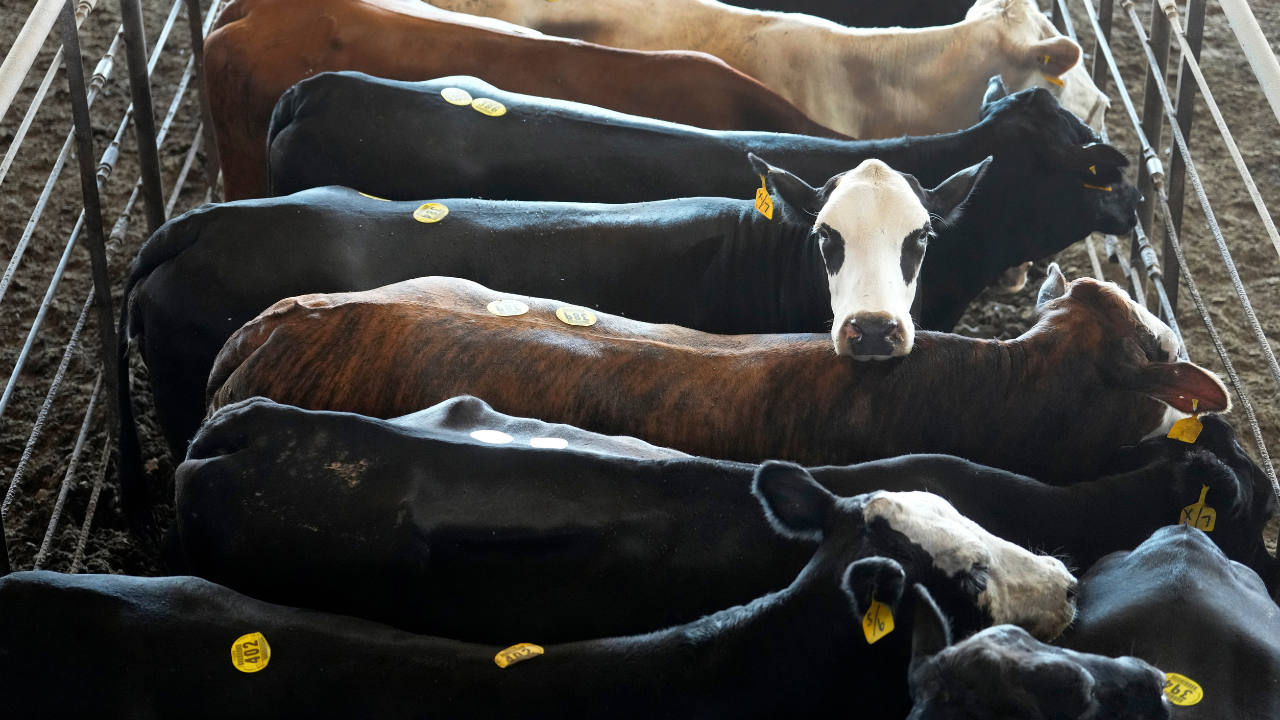
The Justice Department is reportedly pursuing a criminal antitrust investigation of large meatpacking companies after President Donald Trump called for them to face a probe over the higher prices facing consumers.
The Wall Street Journal reported, citing sources familiar with the matter, that while the DOJ indicated it was investigating beef companies following the president's request, the criminal nature of the probe hasn't been disclosed previously.
Trump claimed in November that beef companies were manipulating the purchase price of cattle they bought from ranchers while raising prices on consumers. The report noted that criminal antitrust cases typically focus on allegations related to market collusion or price fixing.
The Journal reported that although Trump's comments placed blame on "majority foreign owned meatpackers," the investigation is looking at four major companies that sell beef in the U.S.
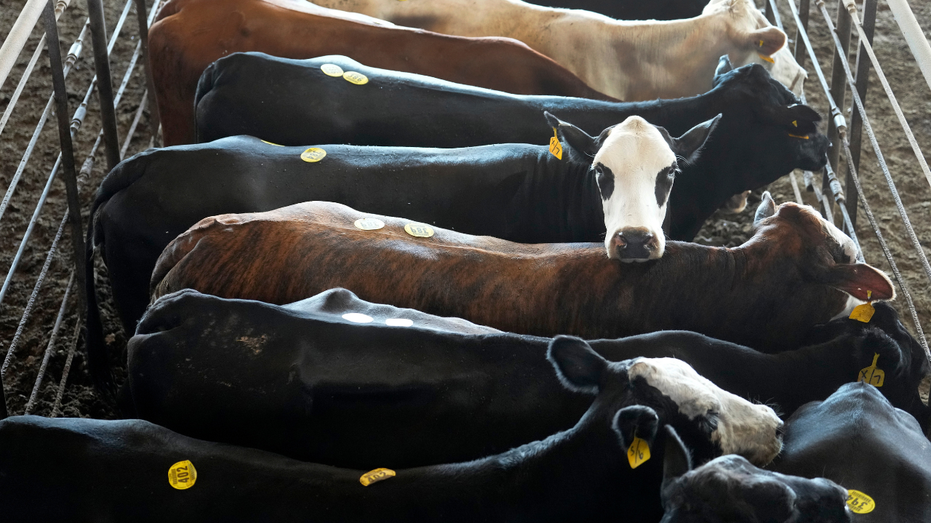
President Donald Trump called for meatpacking companies to be investigated over beef prices last year. (Melissa Phillip/Houston Chronicle/Getty Images)
The report noted that Tyson Foods, Cargill, JBS and National Beef are the four leading companies operating in that portion of the U.S. market, with Tyson and Cargill both U.S.-headquartered firms, while JBS and National Beef are from Brazil.
Antitrust regulators have looked into the contracts used by beef companies to acquire cattle from ranchers which reference a pricing benchmark that some ranchers have claimed is manipulated, one of the Journal's sources told the outlet.
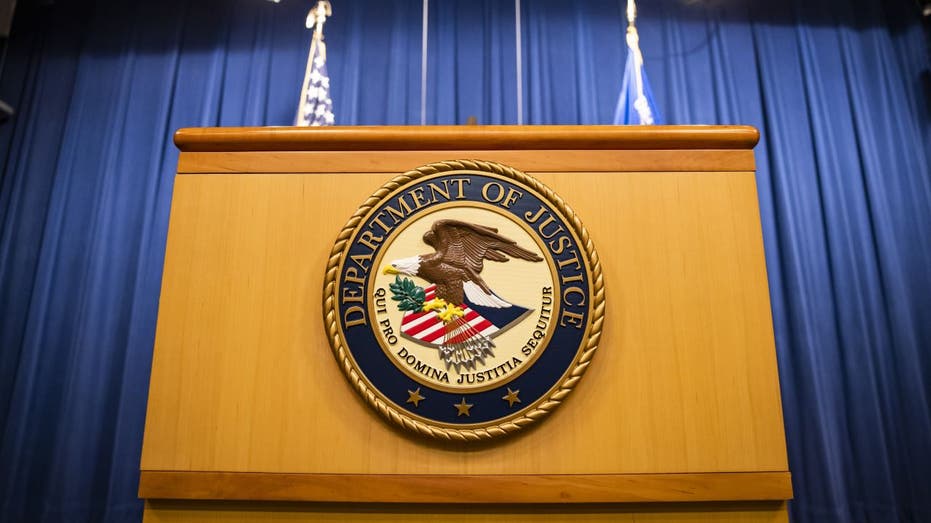
The Justice Department is reportedly investigating meatpacking companies over their dealings with ranchers. (Samuel Corum/Bloomberg via Getty Images)
Additionally, the Journal reported that leading beef processors were the subject of an investigation that began in Trump's first term and continued through Biden's term, but was closed by the Justice Department weeks before it launched its most recent probe on similar grounds.
Beef prices have surged over the last year amid strong demand from consumers while the U.S. cattle industry is facing a shortage with the cattle supply at its lowest level in over 70 years.
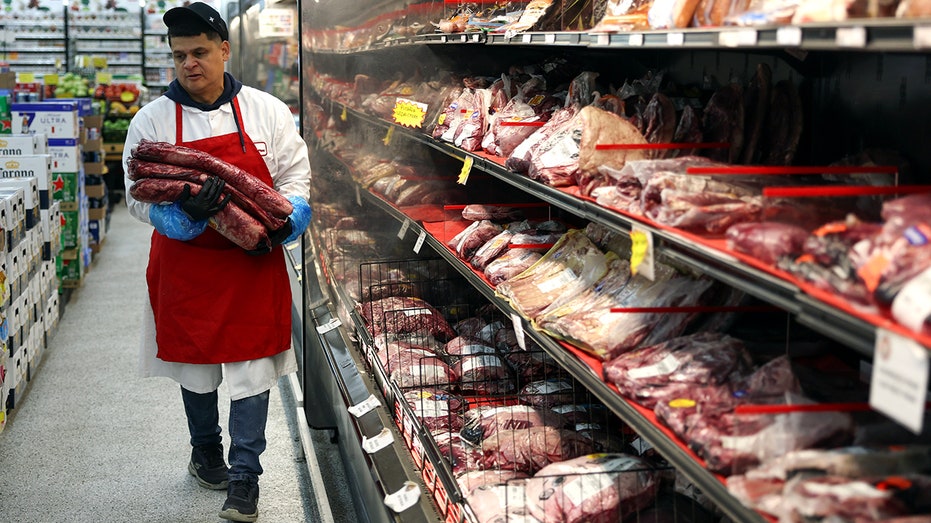
Beef prices have surged over the last year amid the national cattle shortage. (Joe Raedle/Getty Images)
Drought contributed to the decline in the cattle supply, as it impacted grasslands in states like Texas, Oklahoma, Kansas and parts of the Southeast that were used by cattle ranchers' herds. The loss of those foraging areas caused ranches to liquidate cows and shrink their herds.
Ranchers are also facing rising overhead costs, as items like feed, labor, fuel and equipment expenses have trended higher.
The Bureau of Labor Statistics' data from the March release of the consumer price index (CPI) showed that beef and veal prices were up 12.1% over the last year. Within that category, ground beef prices are up 11% while prices for beef steaks have risen 15.2% over that period.
Read the full story at Fox Business.
For complete details, visit the original sources linked above.
Labels: USA Today, breaking news, Business News, Trending News, Markets News, USA News, Top Stories, World
Comments
Post a Comment