Top Stories — Saturday, April 11, 2026
What is trending in the USA today? Here is Breaking News:
- Battles brew over in-state tuition for undocumented students — CNBC
- U.K. Puts Chagos Islands Deal on Hold Following Criticism From Trump — nyt News
- Time to ditch AI anxiety — experts say there’s a lot less to fear than we think — Fox Business
Battles brew over in-state tuition for undocumented students
Source: CNBC • Published: 4/11/2026, 5:50:45 PM

A battle over in-state tuition for undocumented students has been heating up nationwide.
At least 22 states and the District of Columbia allow students — including those in the Deferred Action for Childhood Arrivals program, who are known as "Dreamers" — to pay in-state tuition at public colleges, regardless of their immigration status, according to the National Immigration Law Center. In order to qualify for the benefit, students generally must have attended a high school in the state for a certain number of years and graduated.
For more than two decades, this has been a pathway to a postsecondary education for students who might otherwise be priced out of college.
Initially, such policies had bipartisan approval. Texas was the first state to pass a law to allow undocumented students to qualify for in-state tuition through the Texas Dream Act in 2001.
"This policy allowed for other states to pass an in-state tuition policy and since then 25 states have followed suit," said Gaby Pacheco, president and CEO of TheDream.US, an immigration rights nonprofit. "Trying to ensure that dreamers had access to higher education had a lot of support, but it took years, in some cases, to pass such laws."
Several versions of a federal law gained traction but stalled in Congress.
More recently, however, the political climate changed and a number of states — including Texas — have eliminated the tuition benefit. Several more states are currently challenging their tuition laws.
When Juan, a Quest Bridge scholar, graduated from high school in Galveston, Texas, in 2022, he was accepted into 15 colleges but chose to attend the University of Houston, in part because of the in-state tuition benefit, he said. Juan asked CNBC not to publish his last name due to concerns about his family's immigration status.
When Texas eliminated in-state tuition for undocumented students last summer, "I got really anxious because I was so close to finishing," he said. "If I had to pay out-of-state tuition, it would have been a very tough financial spot for me and my parents. With only a year left, I didn't want to transfer."
Now a senior, Juan, 21, has been able to continue to access in-state tuition rates in Texas despite the state's new restrictions because of his active DACA status. "I know some of my friends that straight up had to leave," he said.
As it stands, the accounting major will graduate with his class in May. "I am going to try and become a certified public accountant and eventually go to law school and become a civil rights attorney or immigration attorney and help people who may not have been as lucky as me," he said.
In July, the U.S. Department of Education issued a new rule determining that undocumented students are not eligible for certain federal education benefits, including federal student loans and Pell Grants, a type of aid awarded solely based on financial need.
"Postsecondary education programs funded by the federal government should benefit American citizens, not illegal aliens," Secretary of Education Linda McMahon said in a statement about the announcement.
"American taxpayers will no longer foot the bill for illegal aliens to participate in our career, technical, or adult education programs or activities," McMahon said. "The Department will ensure that taxpayer funds are reserved for citizens and individuals who have entered our country through legal means who meet federal eligibility criteria."
This notice is subject to litigation and has not been implemented at this time, a spokesperson for the Education Department told CNBC.
"The Departments of Justice and Education are working to target these laws and policies one by one," said Pacheco of TheDream.US. "Years and years of work got unwound."
Under some states' new policies, undocumented students must pay higher out-of-state tuition rates at public colleges and universities. "Out-of-state tuition costs are three times as much," Pacheco said. "Many of them have to drop out or switch to community college."
At four-year public colleges, in-state tuition and fees averaged $11,950 for the 2025-2026 academic year, according to the College Board. The out-of-state tab was $31,880, on average.
"You are going to have a population of students who are graduating from high school and are not able to afford higher education," Pacheco said. Specifically, "it's going to become a lot harder for the non-white or non-rich communities," she added.
In Virginia, a U.S. Department of Justice challenge to in-state tuition rates for undocumented immigrants is currently awaiting a judge's decision, but some experts are hopeful that the state law will remain in place.
"The Virginia Dream Act is not out of hot water yet, but we are confident the judge will land on the side of the law," said Zuraya Tapia-Hadley, CEO of the Dream Project, a state-based nonprofit that awards scholarships to undocumented and other immigrant students who live in Virginia.
About 87% of the nonprofit's scholars rely on in-state tuition rates, according to Tapia-Hadley.
"In Virginia the average in-state tuition is around $14,000 to $16,000 — it would balloon to around $45,000 to $60,000; it would double or triple in cost," Tapia-Hadley said.
If students become ineligible for in-state rates, there would be an "immediate impact," she said.
"The fact is that by causing students to abandon education pursuits entirely, that negatively impacts the entire community," Tapia-Hadley said. "By creating barriers, we would be jeopardizing our future workforce, our pipeline. It's a loss for all."
U.K. Puts Chagos Islands Deal on Hold Following Criticism From Trump
Source: nyt News • Published: 4/11/2026, 5:31:55 PM

Britain said on Saturday that it was suspending its plan to give up sovereignty over the Chagos Islands, which are home to a strategically important British and American military base, following criticism from President Trump.
An agreement to give Mauritius formal control of the islands, a remote Indian Ocean archipelago that Britain has held since the colonial era, had been in trouble since January, when Mr. Trump called the plan an “act of great stupidity.”
Under the deal, reached in 2024, Mauritius would assume sovereignty over the tropical island chain, but Britain would lease the base on its largest island, Diego Garcia, for an initial period of 99 years.
On Saturday, the British government said it was not abandoning the agreement permanently but acknowledged that it could not proceed without Washington’s support.
The developments came at a time of trans-Atlantic tension. Mr. Trump, who initially supported the Chagos Islands deal, denounced it at the height of his bid to acquire Greenland from Denmark, which Britain and other NATO allies opposed.
When the Iran war began in late February, Prime Minister Keir Starmer of Britain refused to let the United States use British air bases to launch attacks on Iran. He later gave permission to use them for defensive strikes, but Mr. Trump has continued to criticize Mr. Starmer and other European leaders for not taking a more active role in the war.
We are having trouble retrieving the article content.
Please enable JavaScript in your browser settings.
Thank you for your patience while we verify access. If you are in Reader mode please exit and log into your Times account, or subscribe for all of The Times.
Thank you for your patience while we verify access.
Already a subscriber? Log in.
Want all of The Times? Subscribe.
Read the full story at nyt News.
Time to ditch AI anxiety — experts say there’s a lot less to fear than we think
Source: Fox Business • Published: 4/11/2026, 5:30:23 PM

More than two thousand years ago, Greek philosopher Heraclitus of Ephesus coined the phrase, "Change is the only constant." That observation has remained true since his death, but now change is happening even faster, largely due to generative artificial intelligence (Gen-AI) technology such as ChatGPT or Claude. And that is making many workers even more anxious than usual. But there’s also some good news for people willing to learn.
"Change is always stressful," Liz Bentley, a workplace and career consultant at Liz Bentley Associates in New York, told FOX Business. Britain’s Industrial Revolution in the 1700s was stressful, too. New industries put people out of work, but new jobs were created. "At the beginning of the Industrial Revolution, people didn’t know there would be new jobs," she says. We now know the 1700s inventions, including steam trains and mechanical weaving, brought prosperity to the U.K. then to other economies.

AI assistant apps on a smartphone - OpenAI ChatGPT, Google Gemini, and Anthropic Claude. (Getty Images / Getty Images)
Gen-AI is driving change to a new level. "It’s coming fast and furious," Bentley says. "There are so many things that AI can usurp." That’s making workers anxious in new ways. People don’t know what changes will happen in the workplace. "There’s a lack of predictability," she says. Gen-AI is the branch of artificial intelligence that creates content rather than just analyzing data.
A few years ago, job losses were often due to employee performance. Now it’s frequently AI displacing the job. Data from Challenger, Gray and Christmas finds Gen-AI was directly involved in firing 54,000 people during 2025. The idea was to let AI handle repetitive work, such as data collection. It’s no wonder that approximately 30% of workers fear losing their jobs as AI agents take over, according to Bentley.
The job losses might sound ultra-scary to a lot of people. But the reality is that Gen-AI is here to stay, and there are plenty of reasons to stop worrying.
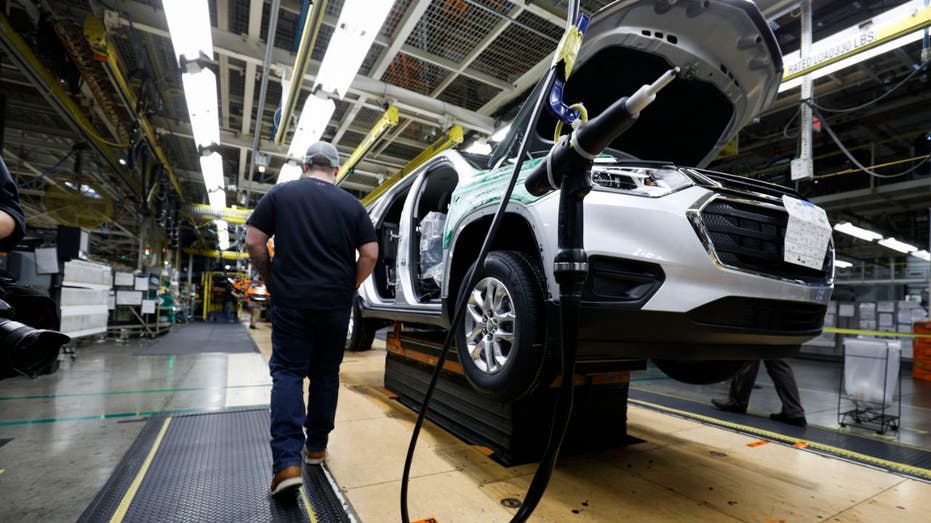
A General Motors worker is shown on the assembly line at the General Motors Lansing Delta Township Assembly Plant on February 21, 2020 in Lansing, Michigan. The plant, which employs over 2,500 workers, is home to the Chevrolet Traverse and Buick Enc (Bill Pugliano/Getty Images / Getty Images)
First, investors have put a boatload of money into making AI work. U.S. private and venture capital investments totaled $109 billion. Last year, similar investors plowed in another $194 billion. Put simply, these investors are betting heavily on the future of AI, and they wouldn’t be doing that unless they thought there was a solid future in it.
In the U.S., 28.3% of the working-age population used generative artificial intelligence, or approximately 3 out of every 10 workers in the second half of 2025, according to Microsoft’s AI Economy Institute. The U.S. was far ahead of the average global usage of 16.3% in the same period.

Business people at their desks in a busy, open-plan office. Startup business people working at a modern office. (iStock)
While AI has so far resulted in layoffs, it’s also created many new jobs that most of us would never have dreamed of. Last year, approximately 280,000 new jobs in Gen-AI were created for people, according to Electro IQ Job Creation Stats. Some of those jobs were for people involved in AI training, data analysis and Gen-AI ethics specialists.
Another positive is that humans working with AI agents are a lot more productive. The amount of work being done by humans assisted by Gen-AI has changed much, Bentley says. But more importantly, workers are now more productive. That’s particularly beneficial for people without advanced degrees or who lack experience, she says.
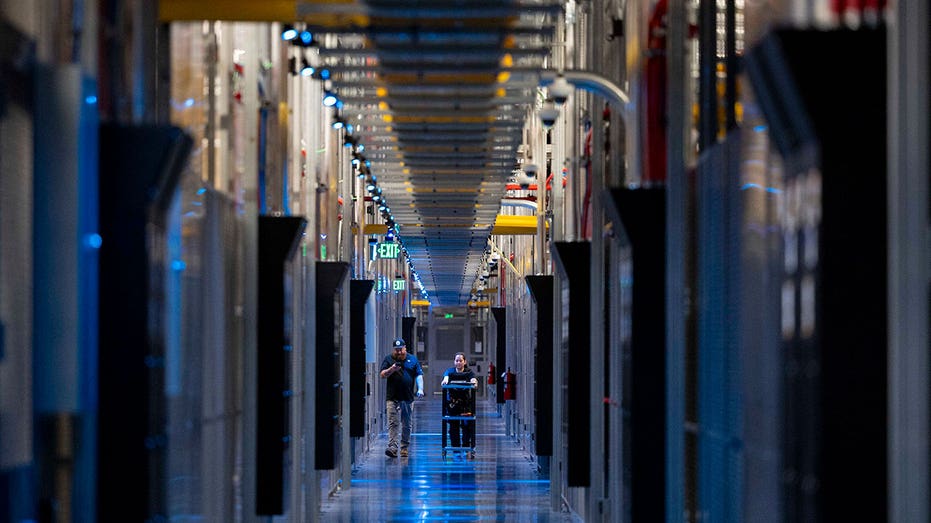
ASHBURN, VA - MAY 9: People walk through the hallways at Equinix Data Center in Ashburn, Virginia, on May 9, 2024. (Amanda Andrade-Rhoades for The Washington Post via Getty Images / Getty Images)
The most important trick in benefiting from these new roles seems to be a willingness to learn. "Those opportunities will include people who will embrace the new technology," Jed Ellerbroek, a portfolio manager at Argent Capital in St. Louis, Missouri, told FOX Business. "And AI can make you a lot more creative."
In part, that creativity comes to life because people working with AI need to do the thinking. Notably, that means critical thinking, which involves questioning answers and challenging perceived wisdom. "It requires a human being," Ellerbroek says.
Ellerbroek says the best way to start learning is to use free Gen-AI agents, such as the basic version of ChatGPT. With that basic knowledge, moving on to a paid version will then be easier. "It’s dramatically better," he says. "You need to double-check the output."
Read the full story at Fox Business.
For complete details, visit the original sources linked above.
Comments
Post a Comment