Top Stories; ASML shares fall after proposed U.S. export curbs target an already fragile China market
Top Stories — Tuesday, April 7, 2026
What is trending in the USA today? Here is Breaking News:
- ASML shares fall after proposed U.S. export curbs target an already fragile China market — CNBC
- 'The thaw is real': Indian delegation visits China to talk EVs and more — CNBC
- Ilhan Omar calls Trump an 'unhinged lunatic,' urges booting him out of office — Fox News
ASML shares fall after proposed U.S. export curbs target an already fragile China market
Source: CNBC • Published: 4/7/2026, 3:56:22 PM

ASML shares fell on Tuesday after U.S. lawmakers last week proposed further measures that would restrict China from additional chipmaking tools and potentially impact the Dutch chip giant's already fragile sales to the country.
Shares of ASML in the Netherlands were down around 2.6% at around 6:11 a.m. ET.
On Thursday, a group of bipartisan lawmakers introduced the Multilateral Alignment of Technology Controls on Hardware (MATCH) Act, designed to cut China off from chipmaking tools and target the country's most critical semiconductor firms.
"While the United States has imposed extensive export controls to slow China's semiconductor indigenization, U.S. allies have not fully matched these measures. This misalignment has left critical gaps that China continues to exploit," said the office of Rep. Michael Baumgartner, R-Wash., who led the bill, in a statement published on April 2.
ASML was not immediately available for comment when contacted by CNBC.
The U.S. has imposed various semiconductor export curbs on China over the last few years.
Much of this has focused on the most advanced semiconductor technology. ASML makes extreme ultraviolet (EUV) lithography machines that are required to manufacture the most advanced chips on the planet.
ASML has never exported any of these machines to China.
The Dutch firm also makes a deep ultraviolet (DUV) lithography machine. DUV lithography machines are less advanced and are used to manufacture other types of semiconductors like memory chips, which are installed in everything from laptops to phones.
Some of ASML's DUV machines have been subject to Dutch export licenses.
The MATCH Act, if passed, would ban even ASML's DUV lithography machines, which can be used to make less advanced semiconductors and which, so far, China's biggest chipmakers have been able to purchase.
In January, ASML said that it expects China to account for about 20% of total sales this year, down from 33% in 2025. This was before the new proposed new U.S. curbs.
If the restrictions come into effect, this could put pressure on the Dutch company's already-falling China sales.
"While the bill is early-stage and its outcome uncertain, it creates a geopolitical overhang. At this stage, it remains unclear whether all DUV tools would be potentially concerned or if current restrictions on some DUV immersion tools ... would be extended," Stephane Houri, head of equity research at ODDO BHF, said in a note on Tuesday.
If a broad DUV ban took place, it would "create some volatility" in ASML's results, "potentially boosting some short term orders (before the restrictions are implemented) but impacting results midterm," Houri said.
"The share price reaction shows that the proposals coming out of Congress in the US could have a fairly material impact on ASML," Ben Barringer, head of technology research at Quilter Cheviot, told CNBC.
"The legislation would impact older versions of the company's lithography tools, which represent around 10%-15% of overall sales. Within that mix, China is approximately 50%, so we are looking at a fairly big hit of around 5%, but one that would likely depreciate over time."
Both Barringer and Houri noted that the proposals are in the early stages and would still need to work their way through the American legislative process.
Washington's various restrictions over the past few years have actually helped boost China's domestic semiconductor industry, analysts told CNBC, with several companies reporting record revenues last year. The country has managed to find alternatives to some of the technology it has been cut off from, such as high-bandwidth memory to Nvidia competitors.
But China's biggest chipmakers, such as Semiconductor Manufacturing International Co. (SMIC) and Hua Hong still rely on ASML's DUV tools to make less-advanced chips.
There is no local alternative to ASML for EUV, and globally, very few options to replace DUV lithography machines.
If U.S. proposals get the green light, they can "disrupt China's semiconductor manufacturing capabilities, as China completely relies on ASML tools today," Houri said.
'The thaw is real': Indian delegation visits China to talk EVs and more
Source: CNBC • Published: 4/7/2026, 3:37:32 PM
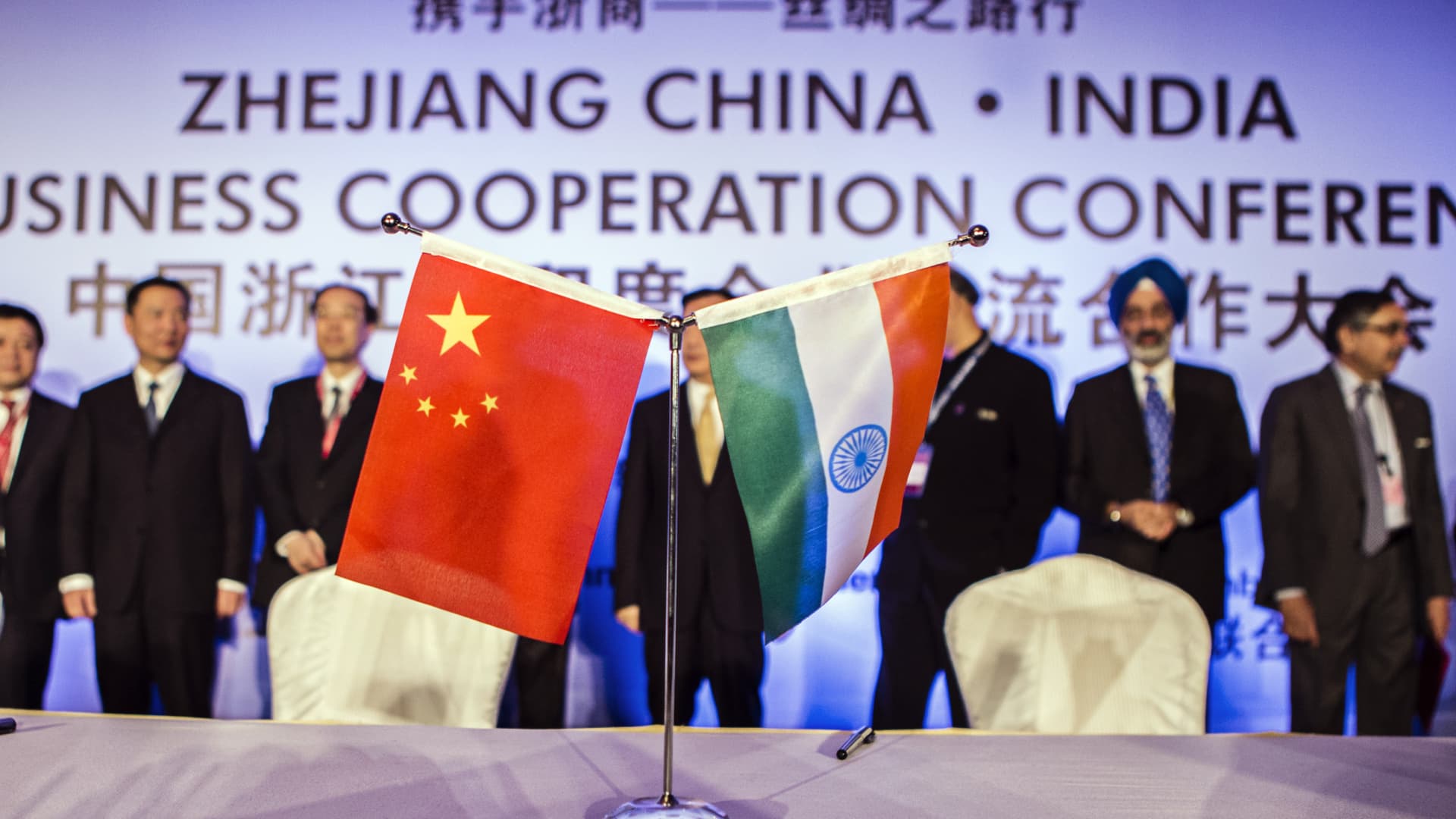
As energy shocks from the Iran war underscore India's fossil‑fuel vulnerability, its companies are turning to China to explore tie-ups in the electric vehicle charging, battery solutions, and renewable energy space.
For the first time in over five years, a delegation of Indian businesses visited China, according to Ranjeet Mehta, secretary general and CEO of Indian trade body PHD Chamber of Commerce & Industry. Between March 29 and April 4, eight Indian companies met Chinese firms from Shanghai, Zhejiang and Wuxi, Mehta told CNBC.
"Energy security is extremely critical for our country," especially against the backdrop of the "problems" arising from the Middle East conflict, Mehta said.
India, the world's third‑largest oil importer and second‑largest consumer of liquefied petroleum gas, or LPG, is heavily dependent on supplies transiting the Strait of Hormuz. Rising energy costs and supply-chain disruptions pose a considerable downside risk to the world's fastest-growing major economy.
Six of the eight companies are startups operating in EV charging, electric trucks, battery storage and energy trading, according to the industry body.
China has developed advanced technology in renewable energy and electric vehicle charging, Mehta said, adding that "India needs those technologies."
India aims for electric vehicles to make up 30% of total sales by 2030, but adoption is being held back by inadequate charging infrastructure and persistent range anxiety.
The Indian industry body plans to revisit China later this year with a larger delegation during the Canton Autumn Fair, a major trade exhibition in Guangzhou.
The visit by the Indian industry delegation marks another step in the thawing of relations between the two major economies.
"First Indian business delegation to visit China in 5+ years just wrapped up in Shanghai," wrote Yu Jing, the spokesperson of the Chinese Embassy in India, in a post on X. "The thaw is real," she added.
Less than a month ago, on March 11, the Indian government eased rules to allow Chinese investments into the country. These rules had been tightened since 2020, when relations soured following a deadly border skirmish in the Galwan Valley, where several Indian and Chinese soldiers died.
The recent visit by the PHDCCI delegation and the relaxation of investment rules in certain sectors are "early signs of renewed interest, though the improvement remains cautious and incremental rather than dramatic," said Ashish Bagadia, partner, corporate finance and investment banking at BDO India.
Indian companies are "keener to form technology-transfer partnerships and JVs" with Chinese companies in India, rather than "taking significant exposure in China," Bagadia added.
The two neighbors have been working gradually to improve ties since last year.
After the U.S. imposed 50% tariffs on India in August last year, Indian Prime Minister Narendra Modi made his first visit to China in seven years to attend the Shanghai Cooperation Organization summit.
Since then, the two countries have taken several steps to normalize relations, including restarting flights and disengaging troops along the border.
"India recognizes it cannot be competitive in emerging technology sectors without some level of commercial engagement with China due to China's dominance in areas such as rare earth elements, active pharmaceutical ingredients, and batteries," Richard Rossow, senior adviser and chair on India and emerging Asia economics at CSIS, told CNBC in an email.
Rossow added that if China wants to maintain export-led manufacturing growth, "it is hard to ignore India's growing market clout," indicating that Beijing is also likely to match India's enthusiasm in repairing ties.
Ilhan Omar calls Trump an 'unhinged lunatic,' urges booting him out of office
Source: Fox News • Published: 4/7/2026, 3:36:36 PM

Rep. Ilhan Omar, D-Minn., called President Donald Trump an "unhinged lunatic" in a Monday post on X, advocating for him to be ousted from office.
"This is not ok. Invoke the 25th amendment. Impeach. Remove. This unhinged lunatic must be removed from office," she asserted.
The left-wing lawmaker made the comments while sharing a screenshot of the president's controversial Easter Sunday Truth Social post threatening attacks against Iranian power plants and bridges.

U.S. Rep. Ilhan Omar, D-Minn., poses for a portrait in her office on Capitol Hill on Wednesday Dec. 10, 2025. (Demetrius Freeman/The Washington Post via Getty Images)
"Tuesday will be Power Plant Day, and Bridge Day, all wrapped up in one, in Iran. There will be nothing like it!!! Open the F[---]in’ Strait, you crazy bastards, or you’ll be living in Hell - JUST WATCH! Praise be to Allah," Trump wrote in the post, referring to the Strait of Hormuz.
Sen. Mark Kelly, D-Ariz., warned in a Monday post on X, "Threatening to target power plants and other non-military targets is not strength. If those words become orders to destroy civilian infrastructure with no valid military purpose, it’s hard to see how they would not violate the laws of armed conflict. America leads best with strength, discipline, and professionalism. Illegal orders to make civilians suffer would be a black mark on our military and our country."
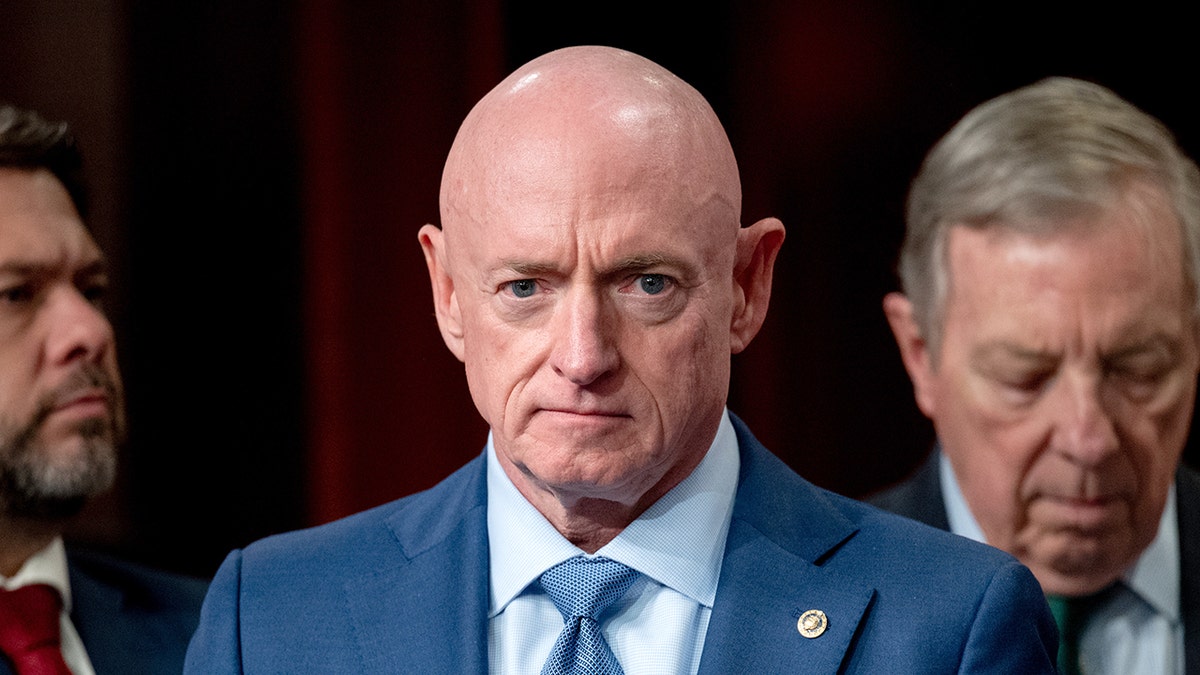
Sen. Mark Kelly, D-Ariz., during a news conference ahead of the State of the Union address at the U.S. Capitol in Washington, D.C., on Tuesday, Feb. 24, 2026. (Daniel Heuer/Bloomberg via Getty Images)
Sen. Jeff Merkley, D-Ore., declared in a Sunday post on X, "President Trump's profanity-laden Easter threat to attack Iran's civilian infrastructure—power plants and bridges—are the words of a frustrated and immoral madman. Many experts agree that such attacks would be war crimes under international law. To our military leaders, remember this: You are legally required to refuse orders to commit war crimes."
Sen. Bernie Sanders, I-Vt., characterized Trump's comments as "the ravings of a dangerous and mentally unbalanced individual," asserting in a Sunday post on X, "Congress has got to act NOW. End this war."
Fox News Digital reached out to the White House for comment early Tuesday morning.
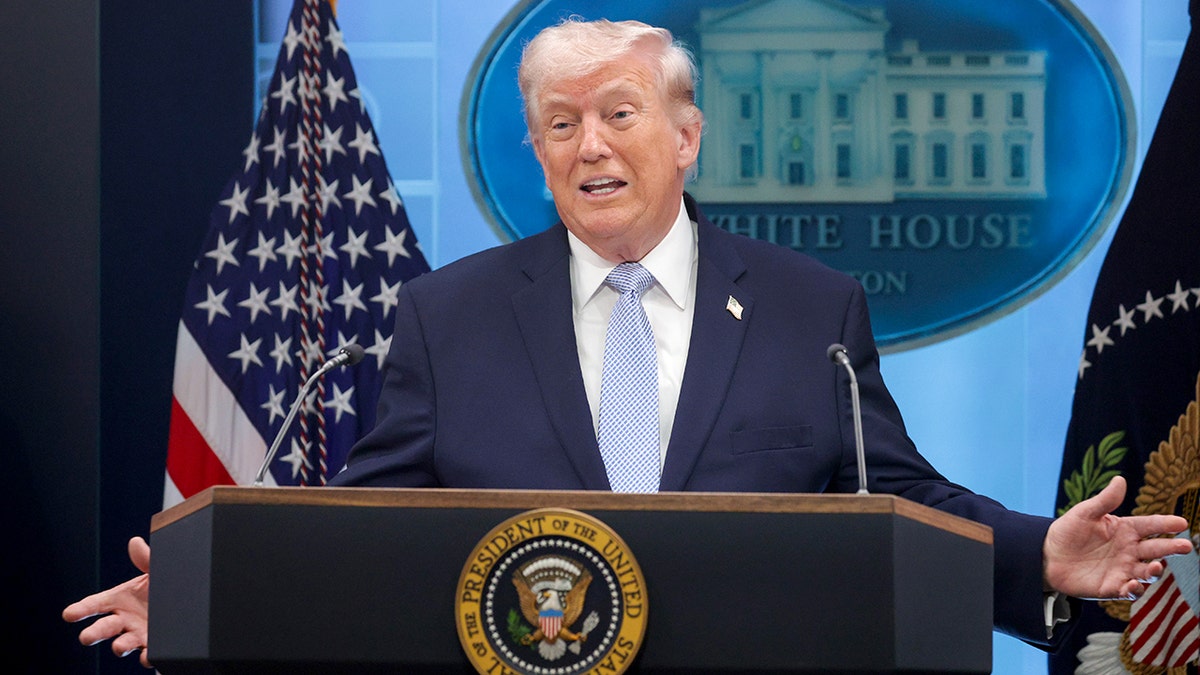
U.S. President Donald Trump speaks during a news conference in James S. Brady Press Briefing Room of the White House on April 6, 2026 in Washington, D.C. (Alex Wong/Getty Images)
During remarks on Monday, Trump indicated the U.S. has "a plan … where every bridge in Iran will be decimated by 12 o'clock tomorrow night, where every power plant in Iran will be out of business, burning, exploding, and never to be used again, I mean complete demolition by 12 o'clock."
"We don't want that to happen," he said.
Alex Nitzberg is a writer for Fox News Digital.
Get the latest updates from the 2024 campaign trail, exclusive interviews and more Fox News politics content.
Read the full story at Fox News.
For complete details, visit the original sources linked above.
Comments
Post a Comment