Top Stories — Monday, September 8, 2025
What is trending in the USA today? Here is Breaking News:
- Microsoft says Azure affected after cables cut in the Red Sea — TechCrunch
- Are bad incentives to blame for AI hallucinations? — TechCrunch
- Stellantis to recall more than 91,000 Jeep Grand Cherokee vehicles over possible loss of drive power — Fox Business
Microsoft says Azure affected after cables cut in the Red Sea
Source: TechCrunch • Published: 9/8/2025, 3:01:17 AM

Microsoft said Saturday that clients of its Azure cloud platform might experience increased latency after multiple undersea cables were cut in the Red Sea, as reported in Bloomberg.
In a status update, the company said traffic going through the Middle East or ending in Asia or Europe had been affected. It did not say who had cut the cables or why.
"Undersea fiber cuts can take time to repair, as such we will continuously monitor, rebalance, and optimize routing to reduce customer impact in the meantime," the status update said.
By Saturday evening, Microsoft said it was no longer detecting any Azure issues. But it seems Azure was not the only service affected, with NetBlocks reporting that "a series of subsea cable outages in the Red Sea has degraded internet connectivity in multiple countries" including India and Pakistan.
According to the Associated Press, Yemen's Houthi rebels had previously denied attacking cables as part of a Red Sea campaign to pressure Israel.
This post has been updated with additional context about affected countries and Houthi denials.
Are bad incentives to blame for AI hallucinations?
Source: TechCrunch • Published: 9/8/2025, 2:53:23 AM

Are bad incentives to blame for AI hallucinations?
A new research paper from OpenAI asks why large language models like GPT-5 and chatbots like ChatGPT still hallucinate, and whether anything can be done to reduce those hallucinations.
In a blog post summarizing the paper, OpenAI defines hallucinations as "plausible but false statements generated by language models," and it acknowledges that despite improvements, hallucinations "remain a fundamental challenge for all large language models" — one that will never be completely eliminated.
To illustrate the point, researchers say that when they asked "a widely used chatbot" about the title of Adam Tauman Kalai's Ph.D. dissertation, they got three different answers, all of them wrong. (Kalai is one of the paper's authors.) They then asked about his birthday and received three different dates. Once again, all of them were wrong.
How can a chatbot be so wrong — and sound so confident in its wrongness? The researchers suggest that hallucinations arise, in part, because of a pretraining process that focuses on getting models to correctly predict the next word, without true or false labels attached to the training statements: "The model sees only positive examples of fluent language and must approximate the overall distribution."
"Spelling and parentheses follow consistent patterns, so errors there disappear with scale," they write. "But arbitrary low-frequency facts, like a pet's birthday, cannot be predicted from patterns alone and hence lead to hallucinations."
The paper's proposed solution, however, focuses less on the initial pretraining process and more on how large language models are evaluated. It argues that the current evaluation models don't cause hallucinations themselves, but they "set the wrong incentives."
The researchers compare these evaluations to the kind of multiple choice tests random guessing makes sense, because "you might get lucky and be right," while leaving the answer blank "guarantees a zero."
The proposed solution, then, is similar to tests (like the SAT) that include "negative [scoring] for wrong answers or partial credit for leaving questions blank to discourage blind guessing." Similarly, OpenAI says model evaluations need to "penalize confident errors more than you penalize uncertainty, and give partial credit for appropriate expressions of uncertainty."
And the researchers argue that it's not enough to introduce "a few new uncertainty-aware tests on the side." Instead, "the widely used, accuracy-based evals need to be updated so that their scoring discourages guessing."
"If the main scoreboards keep rewarding lucky guesses, models will keep learning to guess," the researchers say.
Read the full story at TechCrunch.
Stellantis to recall more than 91,000 Jeep Grand Cherokee vehicles over possible loss of drive power
Source: Fox Business • Published: 9/8/2025, 2:49:17 AM
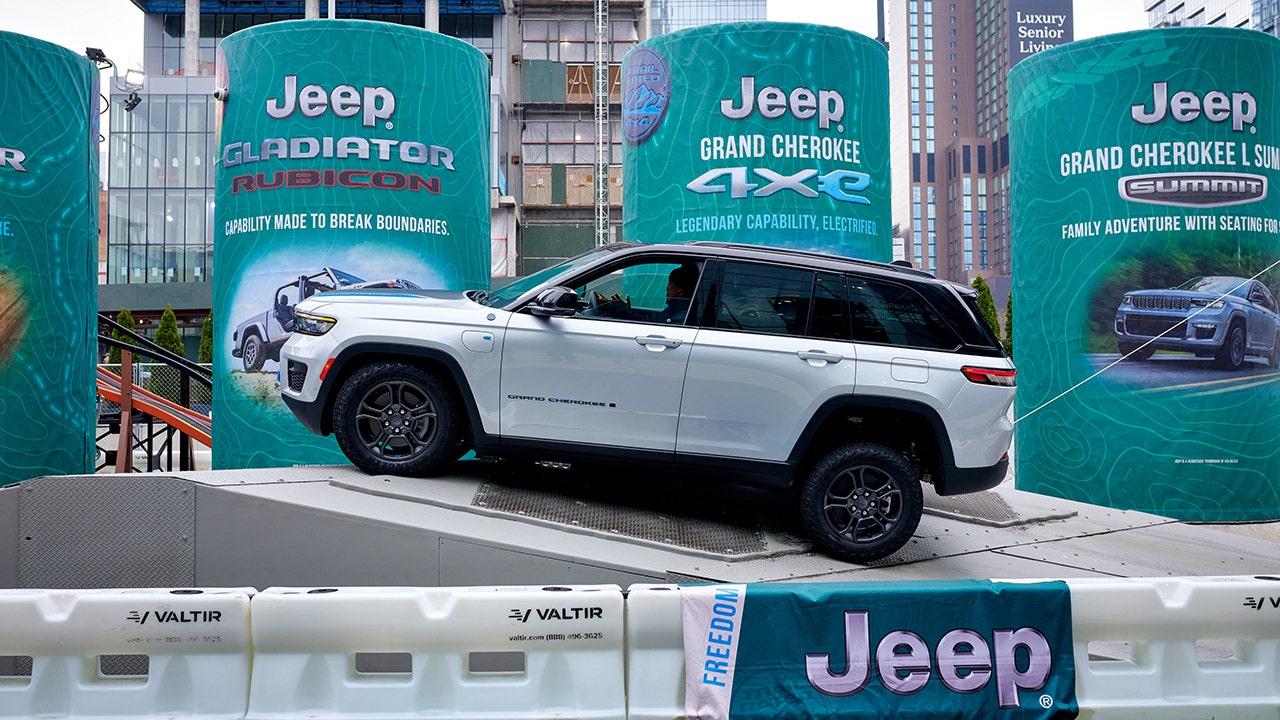
Chrysler parent company Stellantis is recalling more than 91,000 Jeep Grand Cherokee hybrids in the U.S. due to a software malfunction that may result in a loss of drive power, the National Highway Traffic Safety Administration (NHTSA) said on Thursday.
Some Jeep Grand Cherokee Plug-In Hybrid Electric Vehicles, model years 2022 through 2026, may have an overloading of the battery pack control module microprocessor, causing it to reset. When this happens, the hybrid control processor can misinterpret signals from the battery pack control module — potentially resulting in a loss of drive power, the NHTSA noted.
"An unexpected loss of propulsion can cause a vehicle crash without prior warning," the NHTSA noted.
Of the 91,787 possibly affected vehicles, only 1%, or around 918 of them, are believed to have the defect, according to the NHTSA website.
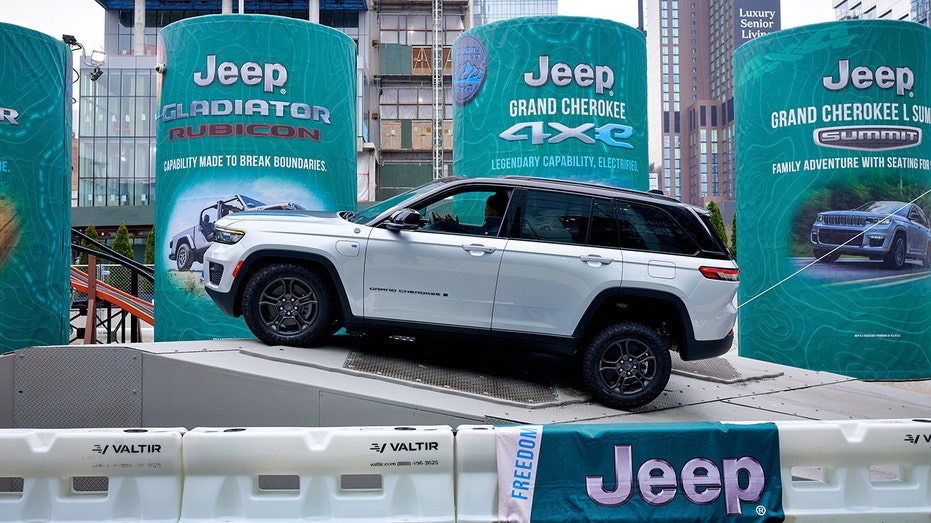
A 2024 Jeep Grand Cherokee 4xe plug-in hybrid sports utility vehicle (SUV) navigates an obstacle course at the 2024 New York International Auto Show on Wednesday, March 27, 2024. (Gabby Jones/Bloomberg via Getty Images / Getty Images)
Similar vehicles that are not part of this recall either do not have a hybrid control processor or were built after the affected timeframe, according to the NHTSA.
Jeep auto showroom, building exterior with company brand name in Manhattan, New York City. (Plexi Images/GHI/UCG/Universal Images Group via Getty Images / Getty Images)
As of Aug. 18, Fiat Chrysler Automobiles had received 96 customer complaints, 110 field reports and 320 other service records linked to the issue. As of the same date, the company is not aware of any crashes or injuries linked to the problem, the NHTSA noted.
On Sept. 11, dealers will be notified, and vehicle identification numbers (VINs) that are affected by the recall will be searchable on the NHTSA website. Owner notification letters will be mailed on Oct. 23, according to the NHTSA.
The Jeep logo is seen on the wheel of a Jeep Grand Cherokee in the showroom at the Massey-Yardley Chrysler, Dodge, Jeep and Ram automobile dealership in Plantation, Florida on Oct. 8, 2013. ( REUTERS/Joe Skipper/File Photo / Reuters)
In a similar announcement earlier this year, the NHTSA said Stellantis was recalling more than 63,000 Jeep Cherokees, with model years 2017 through 2019, due to issues with the vehicles' power transfer units.
In November, Stellantis announced it was indefinitely laying off more than 1,000 employees at its Jeep assembly plant in Ohio as the automaker significantly reduced its inventory levels to match demand.
Stellantis did not immediately respond to FOX Business' request for comment.
Read the full story at Fox Business.
For complete details, visit the original sources linked above.
Comments
Post a Comment