Top Stories; Auto workers union condemns Hyundai working conditions in wake of federal raid on Georgia site
Top Stories — Tuesday, September 9, 2025
What is trending in the USA today? Here is Breaking News:
- Auto workers union condemns Hyundai working conditions in wake of federal raid on Georgia site — Fox Business
- GOP rep targets trucker's English skills after illegal migrant charged in deadly Florida crash — Fox News
- Live Updates: Parliament Burns in Nepal as Protests Force Prime Minister to Quit — nyt News
Auto workers union condemns Hyundai working conditions in wake of federal raid on Georgia site
Source: Fox Business • Published: 9/9/2025, 5:59:11 PM
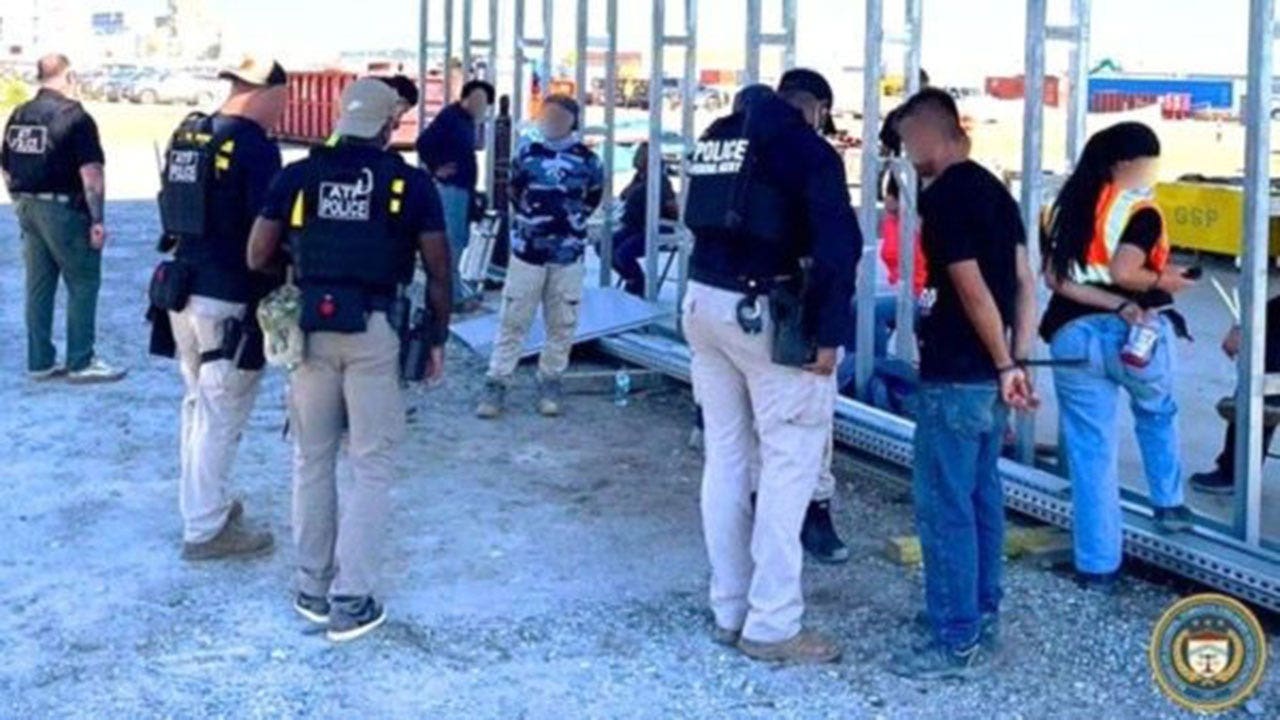
The United Auto Workers (UAW) labor union is condemning Hyundai for what it calls a "disgraceful record on worker safety" following an immigration raid at an electric car battery factory in Georgia.
Most of the 475 people detained on Sept. 4 under suspicion of being in the United States illegally – with at least 300 reportedly hailing from South Korea – were employees of subcontractors, rather than direct employees, LGES and Hyundai Motor Company have said, according to Reuters.
"For years, Hyundai—including its joint ventures and the suppliers that work in its plants—cut corners on industry-standard safety precautions, refused to respect workers' right to a union, and relied on the exploitation of immigrant labor to build its factories and supply chains," the UAW said in a Tuesday press release.
The union says three workers at Hyundai died on the job in the last two years, and called on federal agencies including the Occupational Safety and Health Administration and National Labor Relations Board to "increase workplace safety."
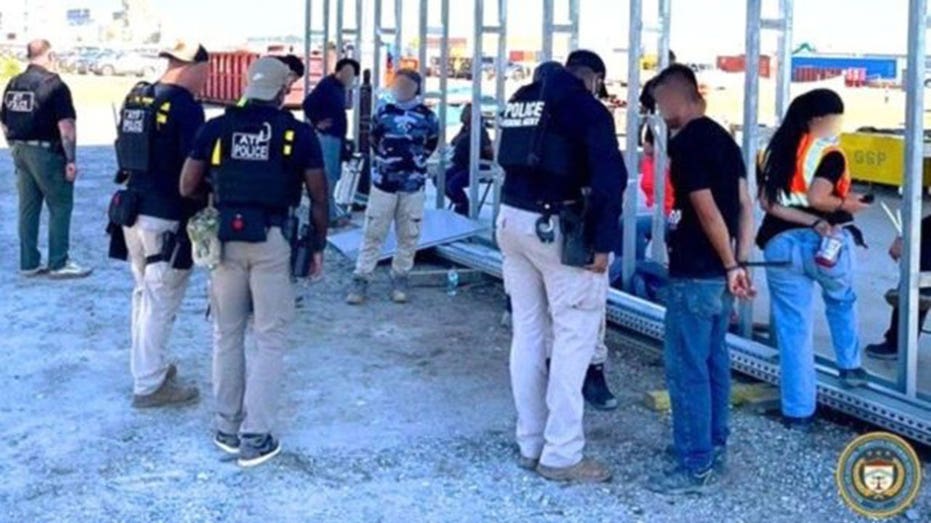
Federal agents detain workers during an immigration raid at the Hyundai battery plant construction site in Ellabell, Ga., on Sept. 4, 2025. (ATF / Fox News)
"Unfortunately, the militarized federal crackdown on these workers further hurts safety at Hyundai. Workers are not the problem. Exploitative corporations are," the UAW's statement said. "The UAW will always stand with all workers—immigrant and native-born alike—against unsafe corporations and militarized attacks on our workplaces."
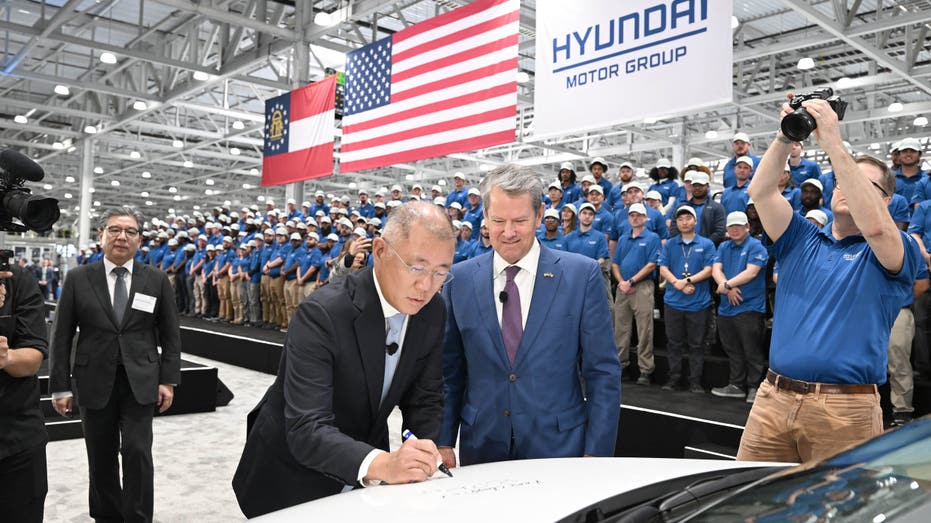
Euisun Chung, Executive Chair Hyundai Motor Group, and Georgia Gov. Brian Kemp sign a Hyundai IONIQ 5 EV at the grand opening of the Hyundai Motor Group Metaplant America on Wednesday, March 26, 2025, in Ellabell, Ga. (Hyundai Motor Group / Fox News)
Hyundai did not immediately respond to a FOX Business inquiry.
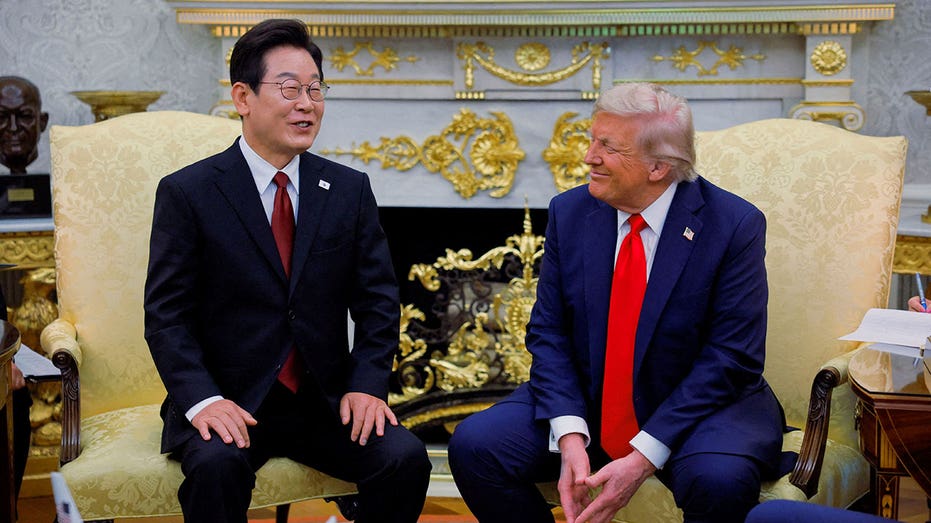
U.S. President Donald Trump meets with South Korean President Lee Jae Myung at the Oval Office, at the White House, in Washington, D.C., U.S., Aug. 25, 2025. (Brian Snyder/File Photo / Reuters)
The detainees in Georgia are now set to be released and sent back to their home country, after South Korea and the U.S. reached an agreement.
Fox News Digital's Charles Creitz and Reuters contributed to this report.
Read the full story at Fox Business.
GOP rep targets trucker's English skills after illegal migrant charged in deadly Florida crash
Source: Fox News • Published: 9/9/2025, 5:58:07 PM
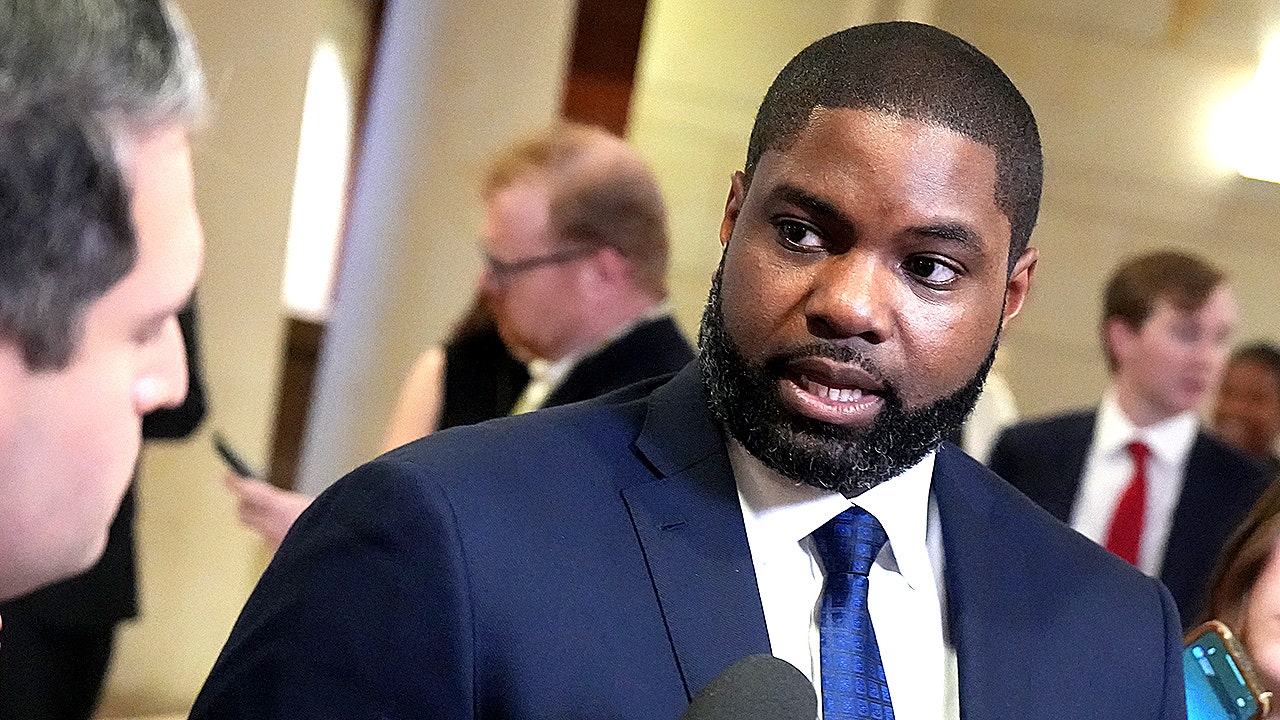
FIRST ON FOX: GOP Congressman and Florida gubernatorial candidate Byron Donalds introduced legislation to enforce English proficiency for truck drivers in the U.S. as an illegal migrant faces three counts of vehicular homicide in the Sunshine State.
Harjinder Singh, an illegal migrant from India, is accused of jackknifing his tractor-trailer on Aug. 12, leading to a deadly crash that took three lives. Singh was issued a commercial driver's license in California, but had also previously received a license in Washington state.
Following the incident, the Federal Motor Carrier Safety Administration examined Singh's English proficiency and road sign comprehension. The illegal migrant was only able to identify just one out of four road signs during the test, and correctly answered only two of twelve questions surrounding his ability to understand English.
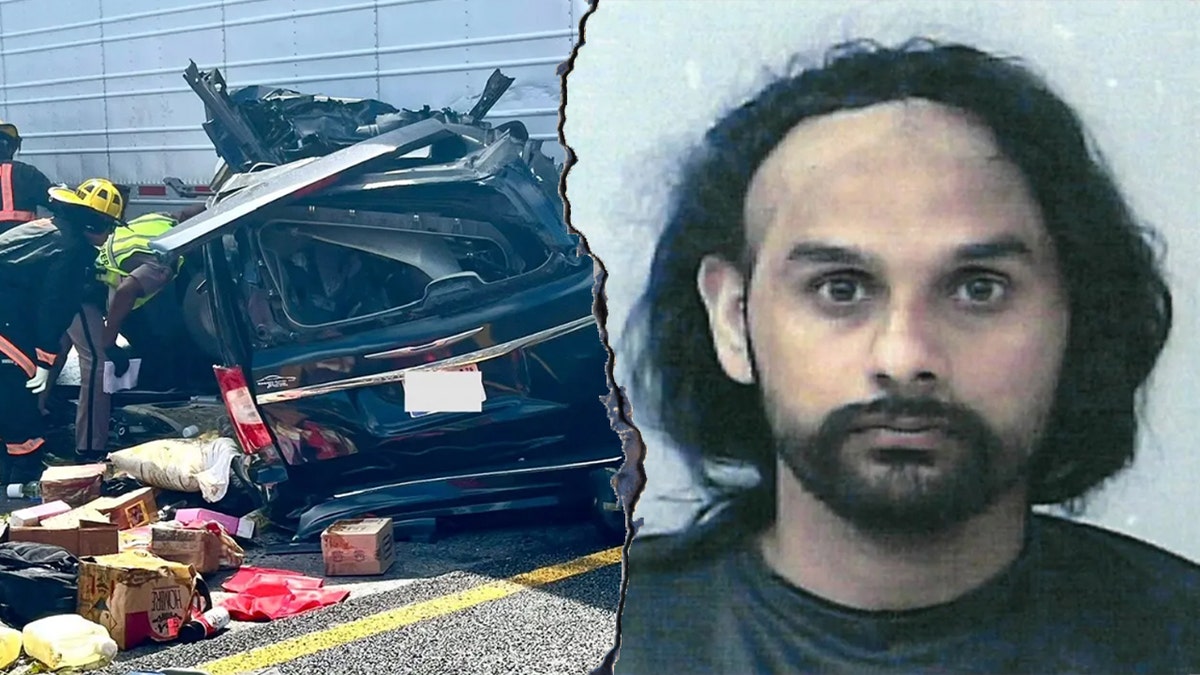
Harjinder Singh, 28, was arrested after allegedly making an unauthorized U-turn in Florida in August that resulted in a crash that left three people dead, officials said. (St. Lucie County Sheriff's Office)
Singh is currently being held in Florida without bond and faces three counts of vehicular homicide.
Under current federal law, to obtain a commercial driver's license (CDL), an applicant must be able to "read and speak the English language sufficiently to converse with the general public, to understand highway traffic signs and signals in the English language, to respond to official inquiries, and to make entries on reports and records."
On Aug. 28, President Donald Trump signed an executive order directing the Department of Transportation (DOT) to further enforce the policy.
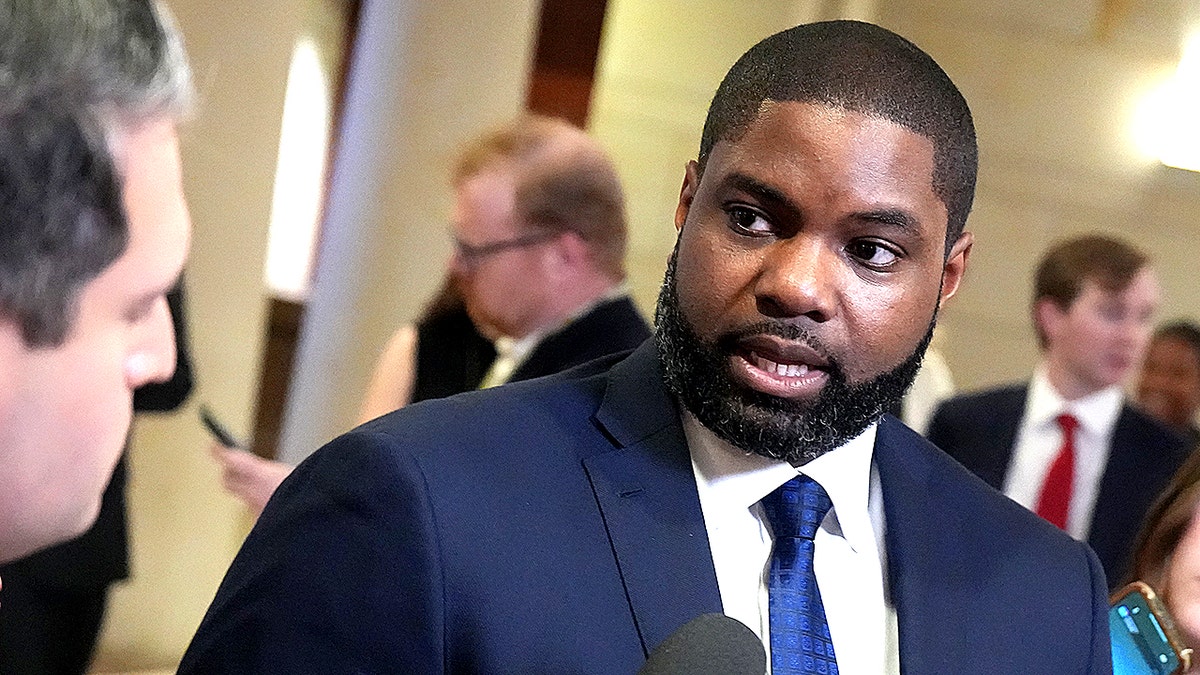
Byron Donalds, a Florida lawmaker and gubernatorial candidate, unveiled legislation empowering the Department of Transportation to assess whether commercial drivers meet English language requirements at interstate weigh stations. (Kevin Dietsch/Getty Images)
The executive order stated that the English proficiency "requirement has not been enforced in years, and America's roadways have become less safe."
Rep. Byron Donald's new legislation, the Weigh station Enforcement to Intercept and Guard Highways (WEIGH) Act, would codify Trump's executive order, and would allow the DOT to utilize weigh stations along federal highways to enforce English proficiency requirements.
"The failure of states to enforce basic and commonsense requirements for truckers is putting every American motorist at risk," Donalds told Fox News Digital. "At the state level, Governor DeSantis and Commissioner Simpson have taken action to protect Floridians, but it's imperative that we expand this effort nationwide.
"Under my 'WEIGH Act,' all weigh stations along interstate highways will be required to enforce President Trump's Executive Order to review commercial driver licenses for irregularities and verify the English language proficiency of truckers," Donalds added. "Safety must be the standard, not the exception, and on Capitol Hill I'm fighting to ensure that the American people are put first every step of the way. The elimination of these threats to the American people is non-negotiable."
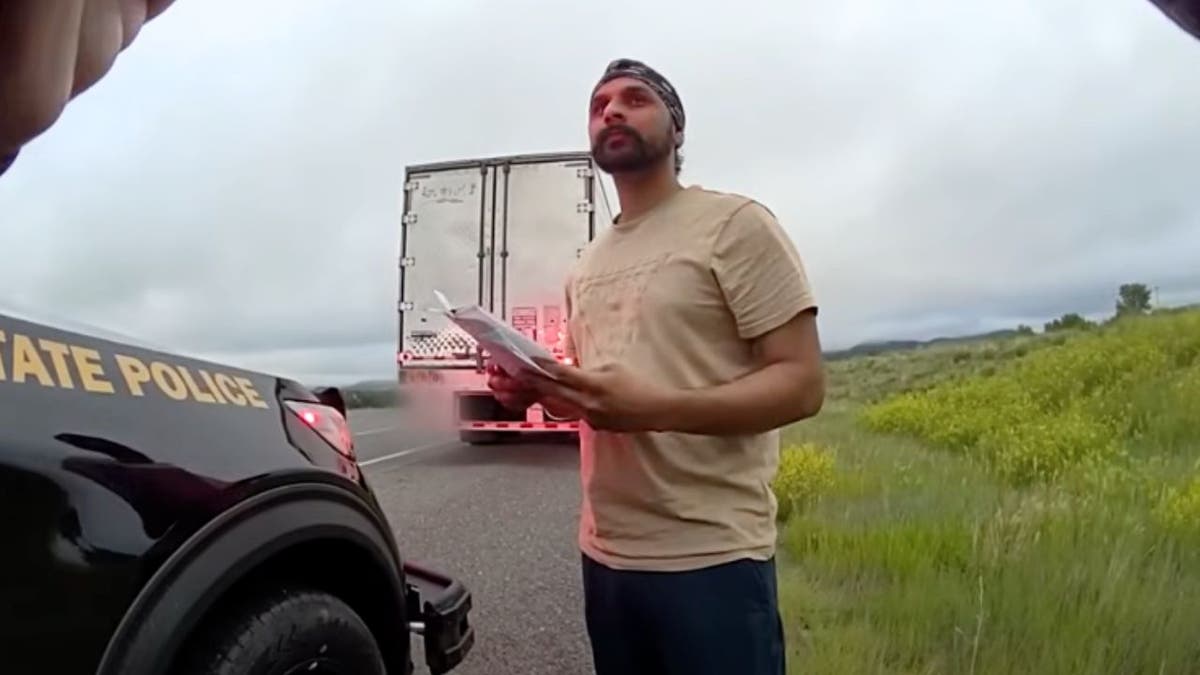
Bodycam still shows Harjinder Singh holding paperwork as a New Mexico State Police officer issues him a speeding ticket during a July 3 traffic stop. (New Mexico State Police bodycam)
While individual states determine their highway law enforcement policy, federal highway funding dollars for states could be in jeopardy should they refuse to comply with DOT requirements enforcing English proficiency checks.
Florida's own Commisioner of Agriculture, Wilton Simpson, told Fox News Digital, "If you can't read our signs, you shouldn't be on our roads."
"If you drive a truck through our interdiction stations, you're prepared for us to check your load for bugs and drugs," Simposon told Fox. "Since [Trump] took office, we have helped take nearly 150 illegal immigrants off our streets — including murders and child predators."
Under most state laws, commercial trucks carrying over 10 thousand pounds are required to stop at weight stations, as well as commercial trucks carrying hazardous materials.
Preston Mizell is a writer with Fox News Digital covering breaking news. Story tips can be sent to Preston.Mizell@fox.com and on X @MizellPreston
Preston Mizell is a writer with Fox News Digital covering breaking news.
Get the latest updates from the 2024 campaign trail, exclusive interviews and more Fox News politics content.
Read the full story at Fox News.
Live Updates: Parliament Burns in Nepal as Protests Force Prime Minister to Quit
Source: nyt News • Published: 9/9/2025, 5:57:58 PM

Kathmandu, Nepal6:22 p.m. Sept. 9
Reporting from Kathmandu, Nepal, and New Delhi
Nepal's leader, Prime Minister K.P. Sharma Oli, resigned on Tuesday amid a second day of raging street protests against corruption and social media restrictions in which protesters in the capital set fire to government offices and to his and other leaders' homes.
A day before his resignation — and those of several other lawmakers — the authorities opened fire into crowds of young demonstrators, leaving at least 19 people dead, in some of the most widespread social unrest in the South Asian country in recent years.
Earlier on Tuesday, Mr. Oli's government had retreated from its decision to ban major social media platforms, including WhatsApp and Instagram, a prohibition that had lit a fuse on years of anger and frustration over official corruption and economic inequality. Officials also declared a curfew in an attempt to head off another day of protests.
But a new wave of unrest quickly engulfed the capital anyway. Demonstrators stormed the main government administrative building, which contains Mr. Oli's office. Protesters also set fire not only to the houses of top leaders but also to their political parties' offices, to police stations and to government buildings, including the Supreme Court and the Parliament. Security forces deployed across Kathmandu, the capital, were unable to protect the properties.
The headquarters of Mr. Oli's Communist Party of Nepal and of the Nepali Congress party were burned. The houses of two former prime ministers, Pushpa Kamal Dahal and Sher Bahadur Deuba, were set on fire, as was that of Mr. Oli. The home of a former home minister, Ramesh Lekhak, who resigned on Monday after accepting moral responsibility for the 19 deaths, was also burned.
Videos posted on social media showed helicopters airlifting ministers from their quarters in the government's main administrative building to safer locations.
Here's what else to know:
Ban reversal: Social media is a critical communication tool for Nepal, in large part because many citizens work abroad and send money back home. Last week, the authorities banned 26 platforms, which also included websites like YouTube and LinkedIn, saying the companies had failed to register with the government. By Tuesday morning, they were all back online.
Airport closed: Tribhuvan International Airport, Nepal's main international airport, was closed on Tuesday as smoke from fires covered Kathmandu Valley. Flights scheduled to land there were diverted to other countries.
Youth and democracy: The demonstrators, who appeared to be mostly teenagers and young adults, have embraced the label "Gen Z protest." Free speech is highly prized in Nepal, which has maintained robust space for debate as similar rights have shrunk in other South Asian countries.
Economic crisis: Outrage has also been growing over economic inequality and what many Nepalese see as the government's failure to aggressively pursue high-profile corruption cases. The country's biggest slow-burning crisis centers on jobs.
Resignations: Mr. Oli had been elected in 2024 for a fifth time as Nepal's top official, and it's not clear who will replace him. In all, four cabinet ministers, including three from the Nepali Congress, which is in a coalition government with Mr. Oli's communist party, known as UML, have resigned.
The sudden collapse in Nepal confirms a recent pattern in South Asia. It was barely a year ago that similar scenes played out in Dhaka, the capital of Bangladesh. The country's prime minister, long the most powerful figure in the country, disappeared after being driven from office by angry street protests. Almost three years ago, the same happened in Sri Lanka. Each protest movement came with a catchy name, student leaders and burned buildings, and each succeeded in toppling an entire establishment.
Balendra Shah, the mayor of Kathmandu and a rapper, emerged two days ago as a supporter of the so-called Gen Z protesters. He said he would not march with them — on the grounds that, at 35, he is too old to be a part of Gen Z — but wrote in a Facebook post that he is on the side of their "spontaneous movement."
With nearly all of Nepal's established political class on the run from protesters, Shah has suddenly become more prominent. In another post, after the prime minister's resignation, Shah wrote: "Dear Gen Z, the resignation of your murderer has come. Now be restrained!!" He urged the protesters to stop destroying property, negotiate with the army chief and insist on dissolving the seated parliament.
Armed men are starting to roam the streets of the capital. It wasn't clear if they were part of the protests.
Tribhuvan International Airport, Nepal's main international airport, has been closed as smoke from fires covered Kathmandu Valley. "There's zero visibility around the airport, so we have closed all flights," said Gyanendra Bhul, a spokesperson for the civil aviation authority of Nepal. Flights scheduled to land there were diverted to other countries.
The prime minister who resigned on Tuesday, K.P. Sharma Oli, was elected in 2024 for a fifth time as Nepal's top official. He leads the communist party of Nepal, known as UML, the second-largest party in Parliament. He had been known for pro-China policies. It's not clear who will replace him.
The Supreme Court building and a special anti-corruption court were on fire. Smoke was also seen pouring out of the Parliament building.
The heads of Nepal's main security agencies, including the army chief, have issued a joint statement appealing for restraint and calling on political parties to find a peaceful way out of the crisis by holding a political dialogue as soon as possible.
You can see black smoke all around Kathmandu Valley as reports of arson increase. Protesters are setting fire to government buildings, police stations and the houses of politicians. My eyes are itching because of the smoke.
Bhadra Sharma reported from Kathmandu, Nepal, and Alex Travelli from New Delhi.
When protesters took to the streets in Nepal's capital this week, expressions of anger and disappointment that had built up for years were ignited. The government's ban on major social media platforms a few days before had only lit the fuse.
Declaring themselves to be the voice of Nepal's Gen Z, the protesters were expressing not only outrage at the official violence that met them on the streets on Monday, but also at longstanding social problems that have afflicted Nepal during the 10 years since it replaced its monarchy with a democratic republic.
On Tuesday evening, Prime Minister K.P. Sharma Oli and other ministers resigned, but the reckoning has only begun.
The country's biggest slow-burning crisis centers on jobs. Getting one is a herculean task in Nepal, a mountainous nation of 30 million sandwiched between India and China. According to the Nepal Living Standard Survey published by the National Statistics Office in 2024, the unemployment rate was 12.6 percent, more than a point higher than it was five years earlier.
Those figures tend to understate the severity of the problem. They represent only participants in the formal economy, leaving out the majority of Nepalis, who work without officially reported jobs, mostly in farming. And the unemployment is heavily concentrated among younger adults who hold out hope for real jobs.
Finding no opportunities at home, hundreds of young men and women leave the country every day to serve long-term contracts in the oil-rich countries of the Persian Gulf and Malaysia. Tens of thousands work in India as seasonal migrant laborers. Government data show that more than 741,000 left the country last year, mainly to find work in construction or agriculture.
The rest of Nepal relies heavily on the remittances those workers abroad — numbering an estimated 2 million — send home. In 2024, the $11 billion they sent accounted for more than 26 percent of the country's economy. That money buys food and medicine and sends children to school in Nepal. The government's social media ban had the effect of isolating families from their faraway breadwinners.
If there were one thing to blame for this cluster of economic problems, many Nepalis, especially those active in this Gen Z protest, would point to corruption. They recoil at the spectacle of a small number of elite Nepalis accumulating vast estates for their children. Transparency International has ranked Nepal as one of the most corrupt countries in Asia.
A steady drumbeat of scandals, typically involving collusion among elected politicians and supposedly independent officials, feeds this resentment. Very few accusations result in successful prosecutions.
For example, a parliamentary probe revealed that at least $71 million was embezzled in the construction of an international airport in the city of Pokhara. Loans from the Exim Bank of China evaporated in a nexus among officials, elected politicians and Chinese construction companies. The probe recommended further investigation and specific actions against the accused, including the director general of civil aviation. Still, no one was booked.
In another case, Nepali leaders were caught collecting money from young people aspiring to find employment in the United States under the cover of refugee status that was intended for ethnic Nepalis who had been forcibly deported from neighboring Bhutan. Fake documents gave the unemployed Nepali nationals the identities of displaced Bhutanese. Politicians from all parties were named in the ensuing investigations, but only members of the opposition were charged.
Ordinary Nepalis are aware of the ways they could benefit from a better-funded government. Health and education expenses are high. Farmers lack critical fertilizer during rice-planting seasons. Inflation makes it tough for anyone to survive in Kathmandu, where young people move to pursue higher education and jobs.
Democracy was hard-won in Nepal, but it has not met the aspirations that sent protesters to the streets this week. Many of the Gen Z protesters are fixated on the son and daughter-in-law of a former prime minister, Sher Bahadur Deuba. They bitterly post images of them and other politicians' children flaunting lavish lifestyles.
Ever since the new constitution came into effect in 2015, three leaders have rotated as head of the government: Mr. Oli, Pushpa Kamal Dahal and Mr. Deuba. For younger people, this electoral game of thrones, in which each prime minister's tenure has lasted just a year or two, is infuriating.
Mr. Oli, the current prime minister, is himself an avid social media user. People close to him say he personally reads the comments that pile up under the videos he posts. Other Nepali leaders are fixated on social media as well, though they may not use the platforms much. In November 2023, the prime minister then, Mr. Dahal, banned TikTok, in order, he said, "to restore social harmony." It was Mr. Oli, when he returned as prime minister, who lifted that ban, nine months later.
The protesters, who have embraced the term Gen Z, said the social media ban, which put platforms including Facebook, WhatsApp and Instagram offline, was effectively an attempt at political censorship by the government. Hundreds were injured in the protests, which also expressed anger at the lack of action over high-profile corruption cases.
Prime Minister K.P. Sharma Oli of Nepal has resigned following the deaths of at least 19 people in protests on Monday. Security forces used water cannons, tear gas and live ammunition in an attempt to quell protests that have been led by young people angry about corruption and restrictions on social media imposed last week by the the government.
Bhadra Sharma reported from Kathmandu, Nepal.

After reacting with force to pitched protests on Monday, a day of clashes that killed at least 19 people, Nepal's government retreated from its ban on some of the world's biggest social media platforms, which had helped to set off the unrest.
By Tuesday morning, all 26 of the platforms that the government blocked last week, including Facebook, WhatsApp, Instagram and WeChat, were back online. But protesters were back on the street despite a curfew, demanding that government officials be punished and replaced.
The protests, which were fueled by anger over corruption and a weak economy as well as the social media ban, have been the most widespread in Nepal's recent history. The security forces' violent response has only added to the pressure on the government. Opposition parties and some members of the governing coalition had called for Prime Minister K.P. Sharma Oli to resign.
In the capital, Kathmandu, protesters surged toward the Parliament complex on Monday, occupying a security post before being dispersed by the police, according to witnesses. It was not immediately clear how those who died were killed, or how hundreds of others were wounded, but the witnesses said the authorities had used live ammunition against the crowd, in addition to rubber bullets and water cannons.
The demonstrators, who appeared to be mostly teenagers and young adults, have embraced the label "Gen Z protest." A Nepalese official acknowledged their youth in disclosing that the government would retreat from its move against more than two dozen social media platforms.
"To address the demands raised by Gen Z, a social media ban will be lifted," Prithvi Subba Gurung, minister for communication and information technology, said in an interview with The New York Times late on Monday.
The ban went into effect on Thursday for platforms that officials said had failed to comply with new requirements to register with the government.
It was not just the social media ban that sent protesters spilling into the streets of the capital and around Nepal. Outrage has also been growing over economic inequality and what many Nepalese see as the government's failure to aggressively pursue high-profile corruption cases.
Local news media reported that at least 400 people have been injured in the unrest.
As protesters in Kathmandu clashed with law enforcement officers, the authorities forbid gatherings in the area around the Parliament complex. The demonstrations continued, however, with protesters blocking highways as troops and paramilitary forces deployed by the government struggled to control the crowds.
Mr. Gurung, the communications minister, suggested that the protests had been infiltrated, exacerbating tensions, without naming anyone or any group. He said an investigation was underway.
Some in Nepal have suggested that supporters of the monarchy, which was abolished in 2008, may have helped foment the unrest. Protests in March demanding restoration of royal rule led to at least two deaths earlier this year. But the demonstrations on Monday were far larger.
"This may be the most violent social and political unrest in modern Nepal," said Prof. Jeevan Sharma, chair of South Asia and International Development at the University of Edinburgh, who is in Nepal conducting research.
Professor Sharma said the social media ban had created "overwhelming anger" and had "curtailed democratic space and freedom of expression."
The protests spread to other parts of Nepal, including Pokhara in the country's center, the Chitwan district in the southwest and Janakpur, southeast of the capital.
In Kathmandu, eight people died after being taken to the National Trauma Center, according to Dipendra Pandey, a doctor there. At Kathmandu Medical College, two others died, and 28 others arrived with injuries, according to another doctor, Bibek Limbu. Three people from the protests died at Civil Service Hospital, according to its executive director, Dr. Mohan Chandra Regmi.
"Our emergency ward is overloaded," Dr. Regmi said.
Free speech is highly prized in Nepal, which has maintained robust space for debate as democratic freedoms have shrunk in other South Asian countries. After a decade-long Maoist rebellion that claimed nearly 18,000 lives, Parliament voted to abolish the monarchy in 2008, and a new constitution was introduced in 2015.
"If the Congress government cannot protect democracy, it must immediately step down," said Rajendra Bajgain, a member of Parliament from the Nepali Congress party, which is part of the governing coalition. He called for lifting the social media restrictions.
Meta, the company that owns Facebook, WhatsApp, and Instagram, did not immediately respond to multiple requests for comment on Monday about its decision not to register with the government under the new law. Late on Monday night, access to some of the company's apps in Nepal appeared to have been restored.
In November 2023, Nepal banned TikTok, saying the app had disrupted "social harmony." TikTok agreed to register with the government, and the ban was lifted nine months later. TikTok remains available in Nepal.
Social media is a critical communication tool for Nepal, in large part because many citizens work abroad and send money back home. Many businesses, too, use platforms like WhatsApp to operate.
Nayana Prakash, a research fellow at the Chatham House research institute in London who studies the use of technology in South Asia, said that governments were often slow to understand that "cutting off these social media tools is also cutting off employment."
She also said that social media had become a vector for criticism of what is perceived to be a two-tier society, in which children of the elite have advantages not available to ordinary people. Hashtags such as #nepobabies and #nepokids have sprung up in Nepal to express that sense of injustice, she said.
The protests on Monday may also have been fueled by social media posts about recent demonstrations in Indonesia and an uprising last year that toppled the government in Bangladesh, both of which appeared to show the political power of young people. Many of those who demonstrated on Monday wore their school and college uniforms to emphasize their youth, witnesses said.
Frustration has also mounted with the two main political parties, the Nepali Congress and Mr. Oli's Communist Party of Nepal, which are in a coalition for the first time, according to Professor Sharma.
"The two big parties have effectively captured the state, the judiciary and the media," he said. "There's no credible opposition in the Parliament."
Responding to the violence on Monday, the United Nations human rights office spokesperson, Ravina Shamdasani, called for a "prompt and transparent investigation" into the day's events. "We have received several deeply worrying allegations of unnecessary or disproportionate use of force by security forces during protests organized by youth groups," she said.
In Nepal, the embassies of Australia, Finland, France, Japan, Korea, Britain and the United States issued a joint statement on Monday affirming "strong support for the universal rights of peaceful assembly and freedom of expression" and urging "all parties to exercise maximum restraint."
Ephrat Livni contributed reporting.
Read the full story at nyt News.
For complete details, visit the original sources linked above.
Comments
Post a Comment